
Introduction
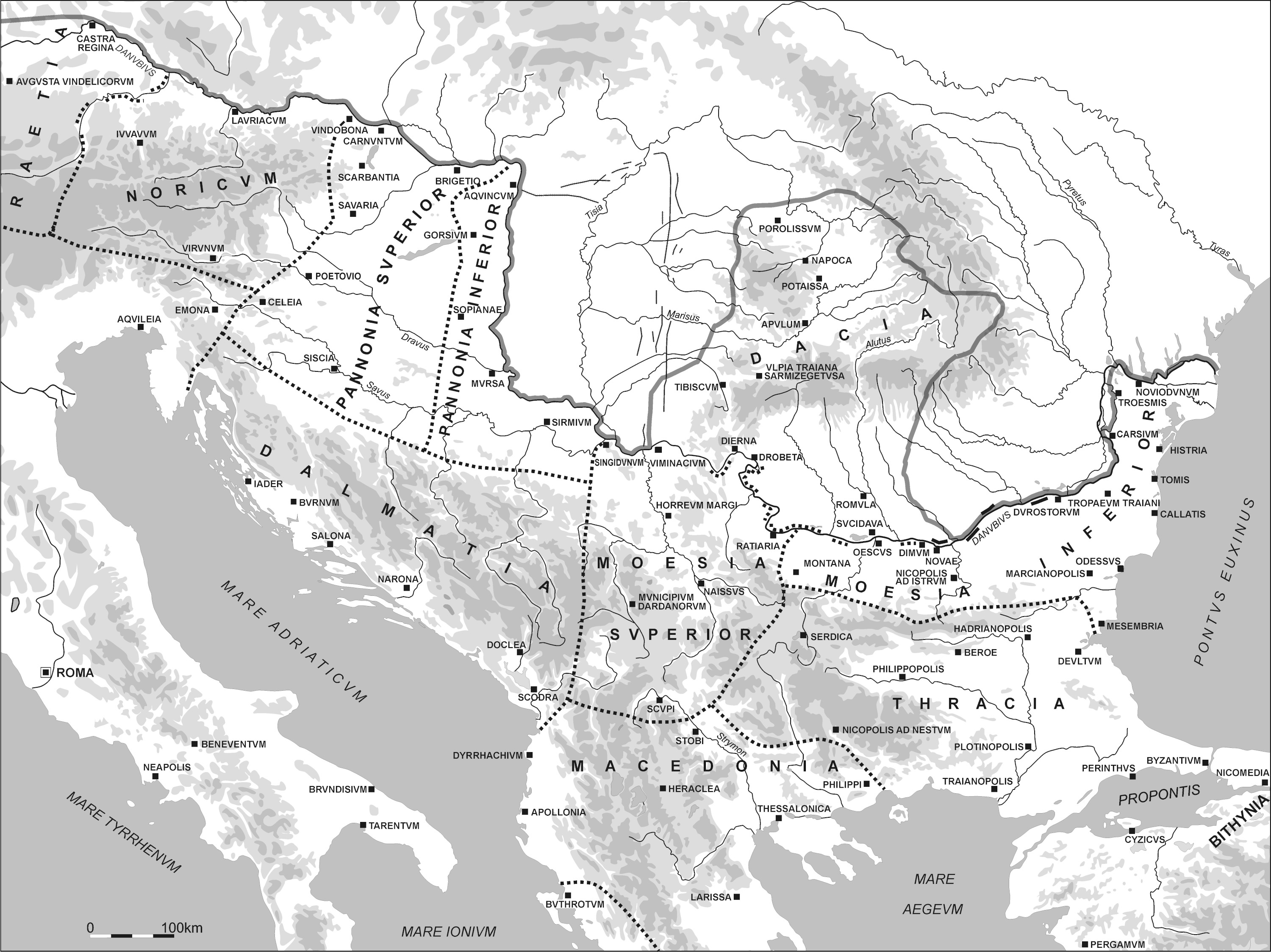
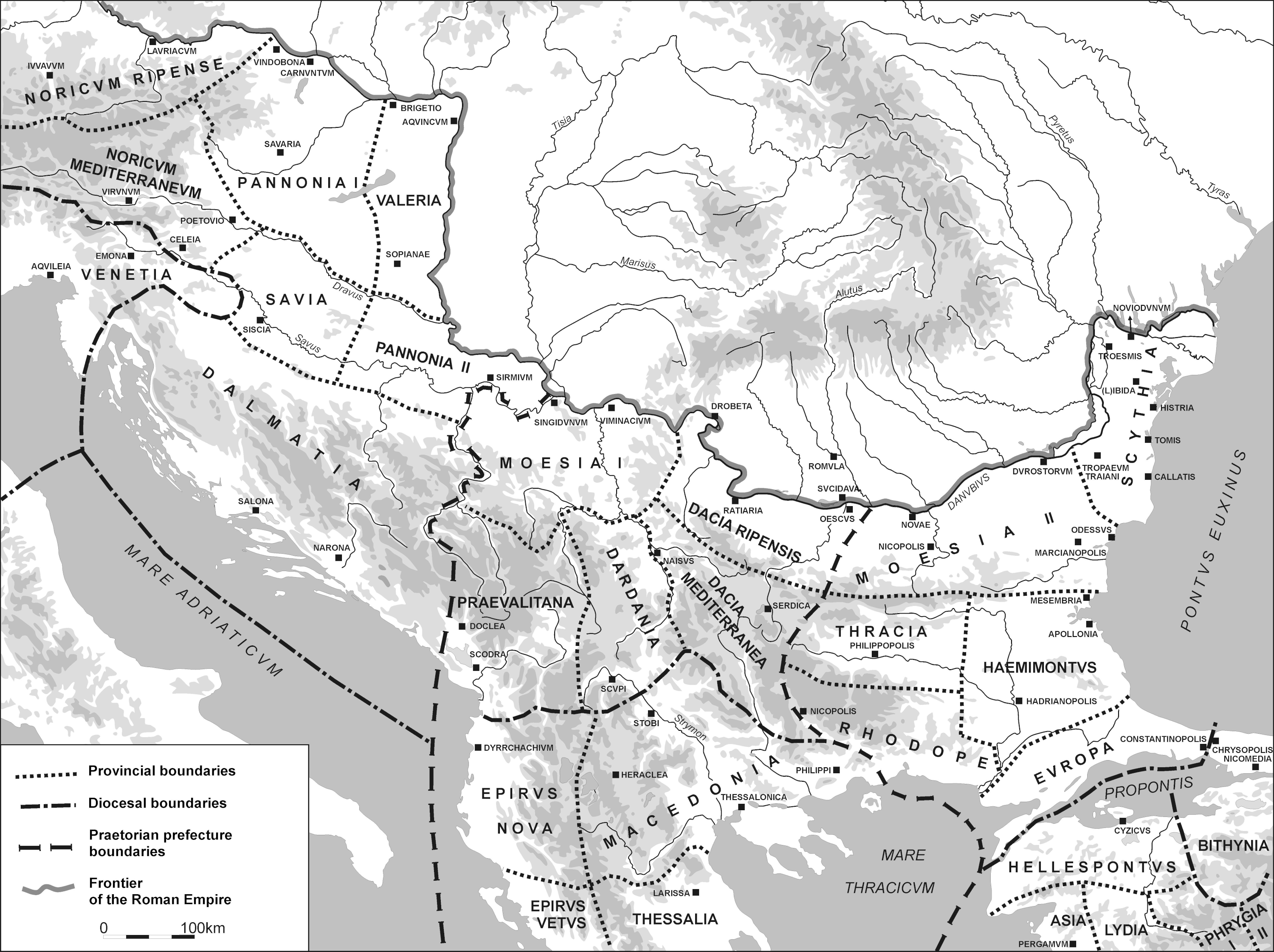
The abandonment of the province of Dacia was in fact the cumulative result of multiple developments during the 3rd century AD. There is no single cause, but a critical analysis of the written sources combined with coin-finds and epigraphic analysis highlights numerous factors. The half-century of crisis,1 beginning in AD 235, was a period of combined pressures due to barbarian invasions, civil wars and rebellions, political instability and usurpers competing for power, as well as plague,2 and debasement of currency with accompanying economic depression; this is often called the period of the Soldatenkaiser (“Barrack Emperors”).3 The Lower Danubian provinces of the Roman Empire (Fig. 1) were directly affected by the ravaging “Scythian War” (238-269) and they were therefore in the focus of the ruling emperors and sometimes of the usurpers. That 30-year-long Bellum Scythicum with the Goths and their allies started under Maximinus Thrax and lasted until the famous victory of Claudius II Gothicus at Naissus in 269. Almost at the end of this period, Dacia north of the Danube was lost and thereafter the frontier of the Empire stood once again on the Danube. A new province named Dacia was created south of the Danube between the two Moesiae, later divided in two: Dacia Ripensis and Dacia Mediterranea (Fig. 2).
Figure 1: The Danubian provinces of the Roman Empire (2nd-3rd centuries).
Credits/sources: Map by Iuliana Barnea.
Figure 2: The Danubian provinces of the Roman Empire (4th century).
Credits/sources: Map by Iuliana Barnea.
The Roman literary tradition
The ancient literary sources involved at our disposal concerning this issue are at the earliest a century later than the events themselves. As it was already observed, two different interpretation are competing on this issue: one is that represented mainly by Sextus Aurelius Victor,4 who placed the events during the reign of Gallienus:
Since his suppression of these was fortunate and beyond what he had prayed for, like men who are lucky he became excessively careless and together with his son, Saloninus, on whom he had conferred the rank of Caesar, he shipwrecked the Roman state, so to speak, to such a degree that the Goths freely penetrated Thrace and occupied Macedonia, Achaea and the border regions of Asia, the Parthians seized Mesopotamia and bandits, or more accurately a woman, controlled the east. At that time, too, a force of Alamanni took possession of Italy while tribes of Franks pillaged Gaul and occupied Spain, where they ravaged and almost destroyed the town of Tarraconensis, and some, after conveniently acquiring ships, penetrated as far as Africa. Even the territories across the Danube, which Trajan had secured, were lost. (Aurelius Victor, Book of the Caesars, XXXIII, 3 = EKG, fr. 83d).5
The second interpretations is illustrated primarily by the magister memoriae Eutropius,6 attributing events to Aurelian, but keeping the tradition that Dacia was in fact lost during Gallienus:
The Alamanni devastated the Gauls and penetrated Italy. Dacia, which had been added beyond the Danube by Trajan, was lost at that time. Greece, Macedonia, Pontus and Asia were devastated by the Goths. Pannonia was ravaged by the Sarmatians and Quadi, the Germans penetrated the Spanish provinces and stormed the renowned city of Tarragona, and the Parthians occupied Mesopotamia and had begun to claim Syria for themselves. (Eutropius, Breviarium of Roman History, IX, 8, 2 = EKG, fr. 83a).7
He gave up the province of Dacia, which Trajan had created beyond the Danube, since the whole of Illyricum and Moesia had been devastated and he despaired of being able to retain it, and he withdrew the Romans from the cities and countryside of Dacia and resettled them in the middle of Moesia and named it Dacia, which now divides the two Moesias and is on the right bank of the Danube as it flows to the sea, whereas previously it was on the left. (Eutropius, Breviarium of Roman History, IX, 15, 1 = EKG, fr. 93a).8
On seeing that Illyricum was devastated and Moesia was in a ruinous state, he abandoned the province of Trans-Danubian Dacia, which had been formed by Trajan, and led away both soldiers and provincials, giving up hope that it could be retained. The people whom he moved out from it he established in Moesia, and gave to this district, which now divides the two provinces of Moesia, the name of Dacia. (Historia Augusta, Divus Aurelianus, XXXIX, 7 = EKG, fr. 93f).9
In fact, it looks like both 4th-century authors are dependent on the same tradition: the Enmannsche Kaisergeschichte (“Enmann’s History of the Emperors”), previously and thereafter abbreviated EKG.10 The latter is an enigmatic yet trustworthy and good quality lost work of late Constantinian dating, which inspired not only Aurelius Victor and Eutropius, but also the authors of Historia Augusta11 and of Epitome de Caesaribus.12 Both epitomizers, Aurelius Victor and especially Flavius Eutropius—who was in fact the most loyal to EKG—used it as a base source, while the Historia Augusta just as a secondary one. For this good reason, Rufius Festus, who summarised Eutropius in a concentrated form,13 and later on Orosius are following this line of information,14 whereas the EKG tradition re-emerged once more in the Roman History (Romana) of Jordanes in the mid-6th century AD,15 relying on Rufius Festus.16 This tradition, followed especially by Aurelius Victor, offered a very negative image of Gallienus.17 Nevertheless, the EKG tradition, as it is preserved both by Aurelius Victor and Eutropius, distinguished between the very first part of the reign, rather positive, and the second one, negative.18 The loss of Dacia belongs to the second, negative, phase of the reign. Without being able to answer the question why Aurelius Victor does not mention the ceding of Dacia by Aurelian and the making of the southern province of Dacia, we can only agree with the opinion that both moments were present in the biography of Aurelian in EKG.19 Perhaps, Aurelius Victor did not want to spoil the perfect image of Aurelian, as an emperor who officially gave up a Roman province, since all other details taken from EKG are present in the text, while only the loss of trans-Danubian Dacia and the making of the new southern province of Dacia are missing.
In short, after the critical analysis of all available unequal sources, one can discern two major events. One during the reign of Gallienus and the other in Aurelian’s time: a loss (amissio) as the sources name it, followed, a few years later, by an organised withdrawal. This is what we learn from the short, heavily abbreviated form given by Rufius Festus, which proves that both moments were present in the imperial biographies of Gallienus and Aurelian.20 Both must have been not only dramatic, but are part of the same series of events. On the other hand, the problems in Dacia are largely comparable to the dramatic loss of agri Decumati, when “sub Gallieno principe … Raetia amissa”.21 These territories of Germania Superior and Raetia were lost under the heavy attacks in 259-260,22 when sub Gallieno imperatore a barbaris occupatae sunt.23 The unhappy events came together with the so-called Gallic Empire of the Batavian usurper Postumus (260-269). Just a few years earlier, a dedication in Hausen ob Lontal (Baden-Württemberg) was the last inscription known north of the Danube. It was offered to the emperors in the beginning of the joint government of Valerian and Gallienus (by the end of 254-early 255), given the imperial title of Germanicus of the latter (CIL, III, 5933). Dacia was the first province lost by the Roman Empire since Hadrian, and we simply have no clues as to how the things developed. However, a new province of Dacia south of Danube is similar to the new province of Germania west of the Rhine after the disaster of AD 9. The former province Germania, which had lasted for two decades, was deserted and practically a new province was built on the Gallic soil, as Tacitus stated (Annales, 1, 31). The same happened approximately 250 years later in the Lower Danube, where administratively speaking, Dacia was simply moved to the south. This was once again a large-scale stroke of the official propaganda, with the abandonment of Dacia presented not as a loss, but as a restoration, and materialised as Dacia nova. The moving of a large part of the population into an area devastated for about two decades by war and invasions,24 which definitely had an important impact on the demography, could also have been seen as a first step of a regained peace.
Initially, almost the entire historiography took into consideration the year AD 267,25 following the Historia Augusta tradition:26
Meanwhile the Scythians sailed across the Black Sea and, entering the Danube, did much damage on Roman soil. Learning of this, Gallienus deputed Cleodamus and Athenaeus the Byzantines to repair and fortify the cities, and a battle was fought near the Black Sea, in which the barbarians were conquered by the Byzantine leaders. The Goths were also defeated in a naval battle by the general Venerianus, though Venerianus himself died a soldier’s death. Then the Goths ravaged Cyzicus and Asia and then all of Achaea, but were vanquished by the Athenians under the command of Dexippus, an historian of these times. Driven thence, they roved through Epirus, Macedonia and Moesia. (The Two Gallieni, XIII, 6-8)
However, taking into account the newly discovered fragments from Dexippus’ Scythica (Codex Vindobonensis Hist. Gr. 73, ff. 192-195),27 I. Piso argued in favour of AD 262 (if not broader, 261/263).28
Epigraphic sources
In Dacia the last official inscriptions in those times of turmoil belonged, as expected, to the military. Two dedications to Aesculapius and Hygia,29 respectively to Fortuna,30 protectress of the baths (Balnearis) were excavated in the legionary thermae at Potaissa during season 2000. Both were close to their initial position, fallen in the south-western corner of Vestibule E of this ensemble. The altars honoured the god of healing and the goddess of health, besides the deliberately erased name of the emperor (damnatio memoriae), who could have been Imp(erator) Gallienus Aug(ustus), although the names of two usurpers have also been suggested: Aemilius Aemilianus (by Ioan Piso)31, Regalianus or even Ingenuus (by Constantin C. Petolescu).32 The dedicator of the above was of Thracian origin, Marcus Publicianus Rhesus, praefectus of the ala I Batavorum milliaria and agens vice praefecti legionis, most likely after 258. The hypothesis that he also took with him the large mounted unit from Războieni-Cetate to Potaissa is plausible, since it fits right in Gallienus’ reforms of strengthening the role of the cavalry units. Together with the legionary cavalry, they were grouped in strategic reserves deployed in or around important centres. This master plan was intended for decisive interventions in vulnerable points of the frontiers. Moreover, inside the legionary fortress from Potaissa there was plenty of space for both units. The poor quality of the stone is consistent with the uncertain identity of the emperor (or usurper) honoured at Potaissa. One should note that the officer’s name at Potaissa—unlike Marcus Simplicinius Genialis, the Raetian governor under usurper Postumus from the famous Augsburg Victory Altar, dated 11th September 260—was left unharmed.33 That means he was not held guilty of any disloyalty. Both the dedication and the damnatio memoriae must have happened during the last decade of Gallienus’ reign, or even later, in any case subsequent to the tactical reforms mentioned above.
A few years earlier, a Donatus is attested once more as praefectus of the same legion V Macedonica (255/256?).34 The inscription reveals military building activities, i.e. a new temple offered to Deus Azizus. Azizus was a celestial divinity from the Syrian Edessa, and it was also known as Bonus Puer in Dacia. Thus, Deus Azizus Bonus Puer Conservator is honoured by the above-mentioned commander. This could be an indirect proof that life in the province did not change very much around 250-260 and nobody foresaw the forthcoming disaster of 262. The previously mentioned double deity formula, Aesculapius & Hygia (Dii magni et boni), is invoked a few years later by M. Aurelius Veteranus, this time praefectus legionis XIII Geminae Gallienianae, who was setting an altar far from the garrison in Apulum, on the occasion of his visit to the famous spa settlement from Băile Herculane.35 He was there, most likely ca 260-261/262, enjoying the still functioning spa and asking for divine help to unknown health problems.
At Sarmizegetusa, before AD 257/258, Valerianus iunior is honoured through a statue.36 The same is true of Cornelia Salonina at Tibiscum.37
In the nearby Mehadia, at Praetorium, the cohors III Delmatarum Valeriana Gallieniana milliaria equitata civium Romanorum pia fidelis was honouring at some time earlier the imperial divine power (numen) and the two emperors, father and son, Valerian and Gallienus, between 257 and the moment when the former was taken captive by the Persian emperor Shapur I in spring 260.38 Many of the above mentioned inscriptions are clearly highlighting the changes initiated by Gallienus, who brought equestrians as agentes vice praesidis, in place of the formerly exclusive senatorial holders.
All these epigraphic sources indicate investment in new buildings and provincial officials that suggest a relatively peaceful province before the disaster of AD 262 or later. Although the south of the Danube was under constant threat, nothing similar seems to have happened before AD 262 in Dacia, at least from the time of Philip the Arab’s Carpic war and Decius’ victories, which gave the latter the title of restitutor Daciarum.39 Therefore, the amissio Daciae was a dramatic and unexpected event. The fact that much of the Dacian army had been sent to other parts of the Empire was probably one of the reasons for the rapid and total collapse of Roman control over Dacia.40 Gallienus was not able to respond and Dacia was lost. One can imagine that losing control over a province for almost ten years would have made a comeback practically impossible, since the cities and the military installations suffered decay, being used only as retreat fortifications.41 Aurelianus had no choice but to build a new Dacia on Roman soil south of the Danube and to transfer to the new province as many of the people from trans-Danubian Dacia as possible. The enlargement of the precincts of so-called Oescus II and Novae II could be connected with the need to settle newcomers. This aspect has been practically ignored, but one should expect that a significant number of military and administrative staff and provinciales fled from the north of the Danube and settled in the new Dacia and in the neighbouring provinces of Moesia Superior and Moesia Inferior, later renamed Moesia I and Moesia II, respectively. A certain Aurelius Victorinus, born in or coming from Serdica, was offered an epitaph by his brother in Rome, during the last decades of the 3rd century. Both were praetorians in the 6th cohort, when Aurelius Victorinus died in harness, at the age of 30. According to the text, the deceased was natione Dacisca and one has plausibly inferred he and his family were refugees moved from Dacia north of the Danube by Aurelian.42 V. Velkov also remarked an unprecedented increase of the number of Latin inscriptions in Serdica during the second half of the 3rd century AD, a phenomenon that lasted to the 6th century, and linked its beginning to the strategic decision of Aurelian.43
Numismatic sources
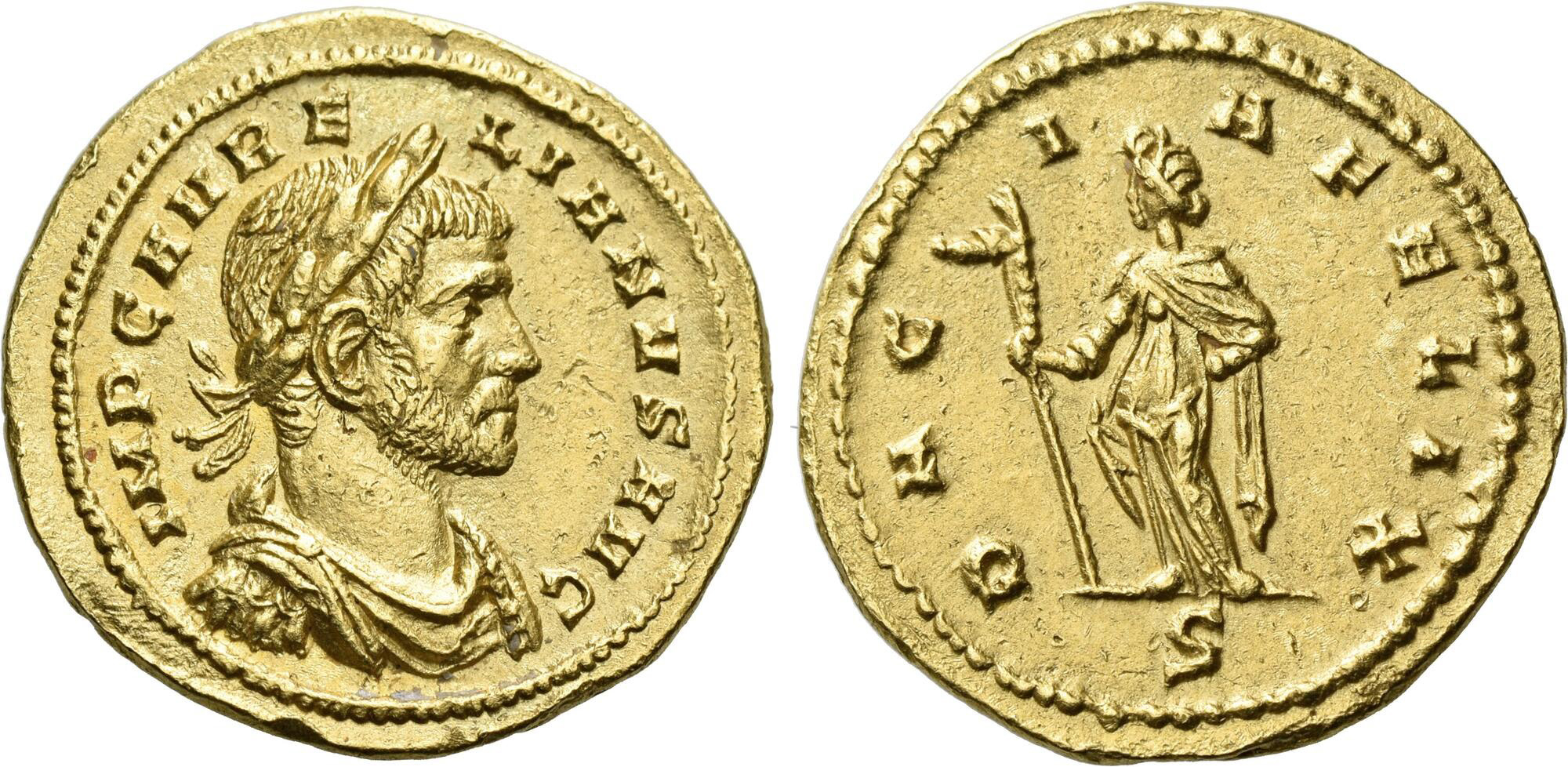
Last but not least, the numismatic perspective44 reveals a drastic reduction of the monetary circulation during the reigns of Valerian and Gallienus (253-268), reaching a dramatic minimum in 260-268 in the most representative cities of the province (Apulum and Potaissa, Ulpia Traiana Sarmizegetusa and Porolissum). Apulum and Potaissa, the two main cities and major military garrisons, nevertheless, have fairly average (or slightly better than average) coin assemblages, but not in any substantial numbers.45 The coin-finds are clustered along the imperial road to the northernmost centre of Porolissum and to eastern Transylvania in the upper basin of Mureș with Târnava rivers.46 The same pattern is observed for the years 268-270. Coins attributed to the reigns of Claudius II and Aurelian were not present at the auxiliary forts, and the same goes for Ulpia Traiana Sarmizegetusa.47 By the end of the reign of Gallienus, Dacia as a whole was practically out of the Empire’s control.48 As for the legionary centres of Apulum and Potaissa, their particular situation is quite curious: the monetary circulation at Apulum collapsed in this final stage, while Potaissa continued under Aurelian.49 Except for an uncertain stray find from the legionary fortress, the few coins from Aurelian and Severina found there belonged to modern collections. No information regarding their topographic or stratigraphic provenance, either military or coming from the civilian settlement, is known for any of them.50 From Apulum, on the other hand, a hoard is known (Apulum III) ending with two antoniniani of Aurelian. It is worth mentioning that the hoard was found in 1905 in one of the rooms (XXXIII) of the private baths in the praetorium consularis.51 Despite this, one should stress a general low level of economic life, but also the weak position of coins within the commercial relationships. Little can be said regarding the coin supply for the pay of the soldiers from the two Dacian legions. Zooming out is, nevertheless, highly appropriate. The monetary production of the central mints during the 260s-270s is well known for its huge quantities of coins, with obvious reinforcement and stabilisation in nearby Pannonia, and a documented abundance in both provinces of Moesia.52 Finally, one should remark that the closing issues of the DACIA FELIX coin series are highly suggestive, as well. The last emperors associated with such coin-finds are Trajan Decius in 251, followed by Claudius II and Aurelian. The latter’s Dacia Felix coins were minted in Mediolanum in December 270-January 271 (Fig. 3) and this was à juste titre interpreted as a terminus post quem for the withdrawal.53 Those gold coins and antoniniani issued in Mediolanum were probably mainly meant for a donativum given to the troops engaged in the large-scale withdrawal operation.54 Subsequently, the mint in Serdica was swiftly reopened during the summer of 271, in the capital of Dacia nova.55
Figure 3: Aureus struck by Aurelian (Milan mint, end 270). Reverse with the legend DACIA FELIX.
Credits/sources: Coin Archives. Numismatica Ars Classica, Auction 146, Lot number 2380 (8 May 2024). https://www.coinarchives.com/a/lotviewer.php?LotID=2367459&AucID=5814&Lot=2380&Val=5a42eacf6427903a2a195f579adf5cc1
South of the Danube and the making of Dacia
At the same time, in the north-eastern part of Moesia inferior provincial life is once again vigorous: an inscription from Callatis ca 274 honored Aurelian as restitutor patriae,56 attesting the progressive recovery after the Bellum Scythicum. The mid-3rd century crisis due to repeated Gothic inroads was gradually overcome through Aurelian’s and Probus’ systematic rebuilding efforts and the process continued during the Tetrarchic regime. An altar was offered to Aurelian by the municipal council of Tropaeum Traiani (ordo splendidissima—precise reflection of ἡ λαμπρότατη βουλή from the nearby Greek Pontic cities),57 while several milestones were set along the reconstructed via militaris by Sexaginta Prista and Capidava in Moesia Inferior.58
After completing the withdrawal from Dacia, Aurelian reorganised a new province bearing the same name south of the Danube, inside the former Moesia, according to his biography in Historia Augusta.59 This short-lived province was called Dacia Aureliana (or Dacia nova), had Serdica as its capital, and the two legions coming from Apulum and Potaissa were assigned new headquarters on the Danube, in Ratiaria (legio XIII Gemina)60 and downstream in Oescus (legio V Macedonica).61 Later the province was divided into Dacia Ripensis and Dacia Mediterranea, having their capitals at Ratiaria and again Serdica.62
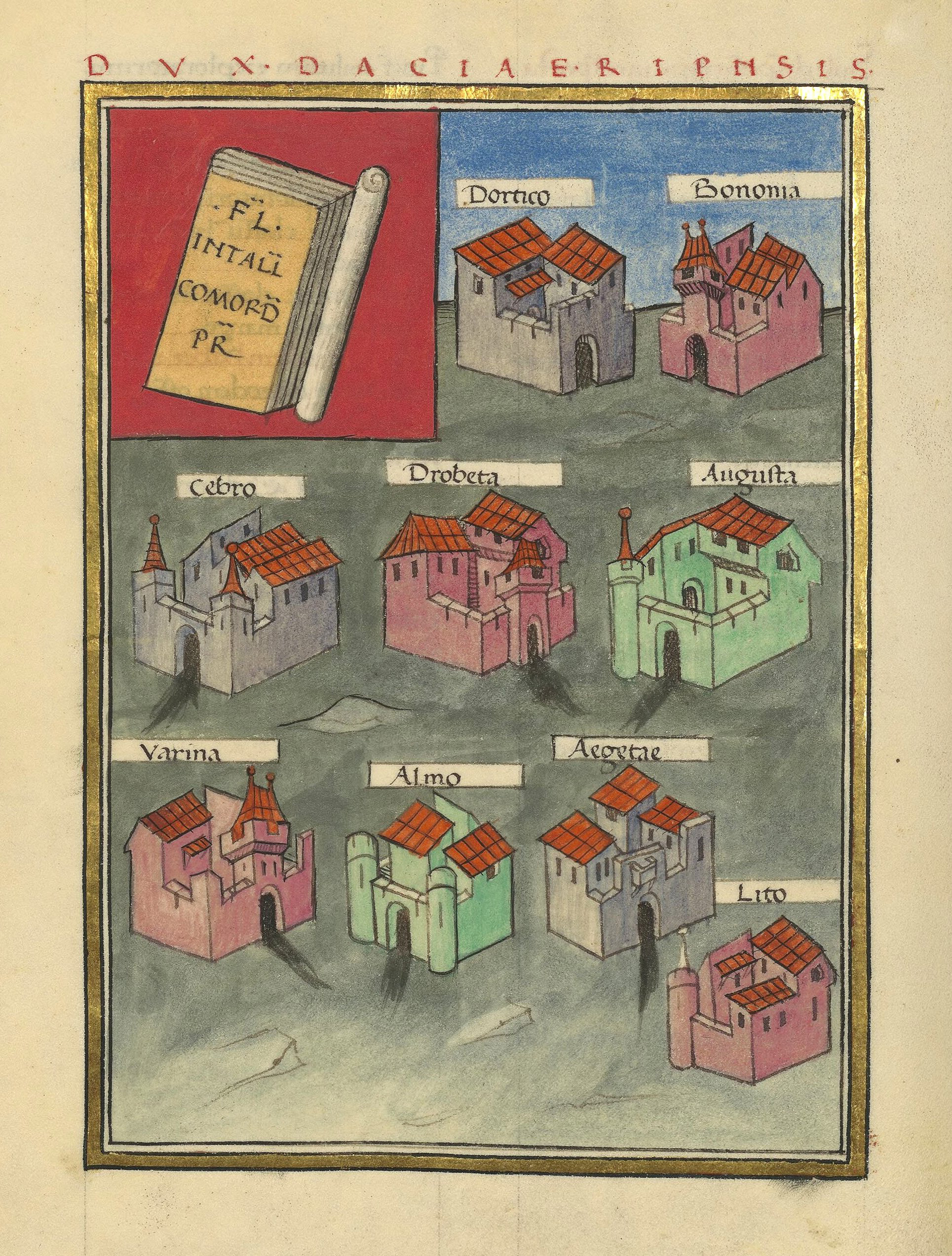
Dacia Ripensis (Fig. 4) stretched along the Danube, from the mouth of the Porečka River, somewhere west of Dierna, and down to the confluence with Utus (Vit), which is almost opposite the mouth of left-bank major tributary Alutus (Olt River). Less urbanised than the neighbouring Dacia Mediterranea, the riparian province was in turn much more heavily militarised and important for its mineral wealth. The governor’s seat was established in Ratiaria (Arčar), where the legion XIII Gemina had already been installed, after it had been withdrawn from Apulum by Aurelian. The existence of Dacia Ripensis is suggested in the early 4th century Laterculus Veronensis, which mentions two Daciae south of the Danube within the Dioecesis Moesiae. Only one duke of the province of Dacia Ripensis is known, a certain Tautomedes, in AD 366.63 A formal distinction between Dacia and Dacia altera was registered around 343/344, on the occasion of the Synod of Serdica. Dacia Mediterranea appears for the first time in an inscription dated 364/367 from Bargala, on the border with Dardania, that also mentioned its governor, Antonius Alypius, vir clarissimus.64
Figure 4: Fortifications on both banks of the Danube subordinated to the dux Daciae Ripensis. Notitia Dignitatum Imperii Romani (Basel?, c. 1436).
Credits/sources: Paris, Bibliothèque Nationale de France. Département des Manuscrits. Latin 9661 (fol. 104 verso).
A Dacia min(or) province is mentioned in the inscription of a sarcophagus discovered at Nicomedia (İzmit, Kocaeli), which is obviously an unofficial way of naming the Dacia south of the Danube.65 It is important to underline that, at least at the moment of his recruitment, around AD 300, the soldier (protector) originated from a region of a still undivided province of Dacia. Another soldier (protector) from the province of Dacia, almost certainly the one created south of the Danube, was also buried in Nicomedia.66 That province, under constant danger during the reign of Diocletian, was restituta in AD 297.67 When exactly it would have been divided is still unclear, since the two Daciae south of the Danube are surely attested, as we already underlined, only in AD 343/344.68 The bronze table from the time of Carus and Carinus does not refer to duae Daciae, as previously thought.69 In AD 313, when Lactantius wrote his pamphlet, only Dacia nova seems to have existed,70 and likewise in AD 321, when Constantine himself wrote to the praeses Daciae.71 It seems therefore that the making of the two Dacian provinces occurred just between AD 321 and 343/344, and was most likely a Constantinian decision, connected to reorganisations after the defeat of Licinius in AD 324. Using an unofficial name for a province in the inscription should not be surprising in this period when things were changing, as one could learn from the famous inscription mentioning the career of Aurelius Gaius.72
Interestingly, there are no traces of the auxiliary units withdrawn from Dacia to the south of the Danube, neither epigraphically nor literary. The Notitia dignitatum records milites Dacisci at Mediolana in Moesia II, as well as an auxilium primorum Daciscorum at Drobeta and an auxilium secundorum Daciscorum at Burgo Zono, in Dacia Ripensis, but it is uncertain that the latter units were created among the former soldiers from various Dacian units.73 This may mean that the units were so demolished that they were never brought to their former strength. Some of the soldiers may have folded into the legions, V Macedonica and XIII Gemina,74 during the Tetrarchic wars and never returned to Dacia Ripensis.
On the left bank of the river, in the segment of limes defended by the future Dacia Ripensis since the start of the Dominate, new fortifications were built or old ones repaired. Their chronology broadly follows that of the neighbouring fortresses south of the Danube. This huge construction effort was archaeologically documented at Dierna, Insula Banului, Drobeta, Puținei, Hinova, Batoţi, Izvoru Frumos, Ostrovul Mare, Izvoarele, Desa and Bistreţ, opposite the fortified points on the right bank (Tekija/Transdierna, Egeta, Aquae, Ratiaria, Cebrus). Most of the former (Dierna, Hinova) are small-sized forts (quadriburgia).75
There is no doubt that the most important bridgeheads controlling more or less extensive territories from the north of the river during the 4th and again during the 6th century AD are the ones in Drobeta and Sucidava. From Drobeta and Sucidava come in fact many of Aurelian’s coins north of the Danube76, and the very high number of the coin assemblage is solid proof for retaining the bridgeheads north of the Danube, regardless of amissio Daciae. Both sites must have been actually the most important evacuation points set up to get the remaining troops and a part of the population out of Dacia. The castellum in Sucidava in particular defended the northern portal of a 2,437 m bridge stretching between Oescus (Ghighen) on the right bank and Sucidava (Celei).77 The great engineering work was inaugurated by Constantine the Great on July 5, 328 and is mentioned by many ancient and Byzantine sources.78 This offensive bridge was defended by a cuneus equitum stablesianorum and supervised by a praefectus of legio V Macedonica, according to the Notitia dignitatum.79 It was in use for several decades, at least until the blocking of the western gate of the Sucidava fort around 364-366, and it most eloquently expresses the active policy of the Empire on the banks of the Ripa Gothica during the 4th century AD. After several Hunnic destructions in the first half of the 5th century, the fort was rebuilt under Justinian.80 Sycibida (Σουκίβιδα) remained functional until the last years of the reign of Maurice (582-602), when it was definitively abandoned by the end of the 6th or beginning of the 7th century.81
Upstream, more stamped bricks of the two legions of Moesia I (IV Flavia from Singidunum and VII Claudia garrisoned in Viminacium) were discovered in several strategic strongholds controlled along the left (north) bank of the Danube, at Banatska Palanka (next to Lederata), Pojejena, Gornea and Șvinița.82 In the sector defended by the province of Moesia I, the fort in Pojejena and the quadriburgium from Gornea are the most significant minor fortifications watching over the left bank of the river.83 The first was destroyed during the great Gothic attacks of the 260s, and soon rebuilt to house vexillations of the legions of Moesia Superior (a detachment of legio VII Claudia, coming from Cuppae).84 It functioned until the 4th century, at least under the Constantinian dynasty, when the local horreum was rebuilt, as documented by a coin of Constantius II (337-361) found in the mortar of its masonry. The small-sized fortification in Gornea seems to have enjoyed an even longer life: built very likely by equites sagittarii led by a praepositus named Italicus85, it served until the early decades of the 5th century, when it was destroyed by the Huns.
Conclusions
To sum up, based on the evidence tackled above, one should notice that the Dacian provinces were restored, after the crises during the reigns of Philip the Arab and Decius (restitutor Daciarum). During the 250s-260s, when the south of the Danube and even some of the Mediterranean regions faced constant attacks and plunders, the provincial life went peacefully in Dacia. New buildings were erected, the destroyed forts were rebuilt, and everything seemed to go back to normal. There were also some significant developments that, however, proved decisive during the disaster of 262 (or 261/263). The most important one was obviously the weakening of the garrison by sending detachments in other parts of Empire, especially in Pannonia and northern Italy, as part of Gallienus’ field army.86 Moreover, one could also think that the units were not brought up to their strenght anymore, as some of the reorganisation actions hastily undertaken (blocking of the gates, repairs of the curtain walls using earlier sculptural or epigraphic material, the “encroachment” and subdivision of internal space, including the via sagularis, by secondary structures introducing sloppy walls) considerably affected the internal layout of the forts. The coming of the entire ala I Batavorum milliaria (obviously with a smaller number of horsemen than usual) from Războieni in the fortress of the legion V Macedonica at Potaissa exemplifies precisely this phenomenon. It is also possible that part of the civilian population, especially in the frontier zone, relocated inside the forts and caused significant supplementary changes of their internal planning. It all happened not because of undergoing attacks and plunders, but because the buildings from the vici militares were destroyed during the previous raids and it was too expensive to begin the reconstructions. This aspect was not so much acknowledged so far. Even so, the relocation of the families of the soldiers inside the forts does not directly mean the decay of the provincial life, but rather a more convenient solution than the rebuilding. We do not have any information about the territory of the cities, forts and fortresses, but probably, leaving aside the possible troubles caused by the bandits, it was relatively safe and suitable for crops. The travel from Potaissa to the spa of Băile Herculane suggests that the province was safe and the life went on without many problems.
Something not explicitly specified in the literary sources happened most likely in 262 and everything collapsed. The empire lost control of the north of the Danube and the remaining units did not receive any payments. The situation remained unstable up to the accession of Aurelian, who simply considered that the province could not be regained and its defence impracticable. Therefore he proceeded to the shortening of the frontier and bringing its limit on the Danube, with the Dacian troops mostly redeployed along the river.87 His Dacicus Maximus title (272?) must be linked to an earlier conflict, unspecified by the sources.88 The future Restorer of the World (restitutor orbis) swiftly decided to make another Dacia, as Augustus made a new Germania as two different military districts after the loss of the territory conquered by Drusus the Elder. The withdrawal was conducted at high speed, following the main imperial road from Porolissum to Drobeta and along the Olt river, heading to Oescus. The abandonment of Dacia Traiana in 271 was accordingly presented by the official propaganda as a successful restoration. The identical name given to the new province south of the Danube defended by the same two legions (V Macedonica and XIII Gemina) was obviously meant to infer the impression that actually nothing had been lost.
The impact was also felt south of the Danube, and most likely the enlargement of the fortresses of Oescus and Novae (Oescus II and Novae II)89 are directly connected with the need to host new units and new settlers from the north of the Danube. At Ratiaria, it seems that the late antique area did not overlap the former structures, but the surveys and archaeological excavations were resumed only one decade ago.90 If this observation will be confirmed, then it is possible that the location of the settlement changed upon the arrival of the legio XIII Gemina and afterwards, during the Constantinian period, in the making of the province of Dacia Ripensis (a lavish residence for the governor and the public bathhouse are currently under systematic excavation). The same goes with the rebuilding of both bridgeheads, Drobeta and Sucidava, a reconstruction process that very probably began during the reign of Aurelian. Not to speak about other epigraphic and archaeological attestations of rebuilding and reshaping of the former auxiliary forts along the Danube, from the Iron Gates area downstream, to the late Roman province of Scythia.
Last but not least, the epigraphic material clearly suggests a sudden and massive implant of Latin-speaking citizens in the future province of Dacia Mediterranea, more precisely in the area of Serdica, at that time a rather exclusively Greek-speaking milieu. Those events reversed the local ratio between Greek and Latin inscriptions until the very end of the Roman rule. Moreover, the political decision of including in Dacia Nova that area remote from the Danube frontier could and should be related with the very subjects settled to the core of the Balkans during the controlled evacuation from the north of the river.91