
This article deals with a traditional myth still vivid nowadays linking Tokaj wines to metallic gold through an ancient belief substantiated in the so-called aurum vegetabile.
The existence of the aurum vegetabile or so-called plant gold, or végétal in French, dominated scientific thinking for centuries: it was described as an existing phenomenon, and its reality has been demonstrated with many illustrative – believed to be true – examples. Its Hungarian references are also well-known: in the Late Middle Ages, it was used to refer to the golden particles and cuttings growing among plants, especially grapes, and from the 17th century onwards, there were also reports of gold grains in grapes, increasingly localizing these phenomena to the Tokaj-Hegyalja wine region.
The Italian historian humanists working at the court of King Matthias I in Buda: Antonio Bonfini (1427-1503) and, the Bishop of Lucera, Pietro Ranzano (1428-1492), reported on Hungarian plant gold without mentioning any particular region. Bonfini wrote in his Rerum Ungaricarum decades1 that gold nuggets of high quality can be found in many rivers, but gold is also found in the grapes of gold-containing lands (Bonfini 1568). Pietro Ranzano, in the first chapter of Epithoma rerum Hungaricarum2, reported that he had seen with his own eyes gold particles growing in some vineyards, as long as a finger or even half a foot (Ranzano 1558). Galeotto Marzio (1427-1497) mentioned the grapes with golden tendrils of the Srem District (or Szerémség, now in Serbia) in chapter xxvii of his work De egregie, sapienter, et iocose dictis et factis Mathiae Regis3, summarizing the wise sayings and deeds of King Matthias I: gold grows in these vines like shrubs, asparagus or grape particles, because they come from veins in the earth, which contain reborn and reconstructed gold (aurum renatum) (Marzio 1563, p. G2). Such natural gold is often used to make rings, as it can be easily bent around the fingers; he also had a piece of jewellery made from such a gold leaf.
Antoine Mizauld, a Parisian physician (c. 1520-1578) and very prolific writer, also mentioned the golden cuttings growing near the grapes of Sirmium (in Hungarian Szávaszentdemeter, now Sremska Mitrovica, Serbia), in his volume released in 1574 (Mizauld 1574, p. 24-25). Mizauld’s story was based on the work of Battista Fregoso of Genoa (Baptista Fulgosius, 1452-1504) and his commentary by Gaudenzio Merula (1500-1555). Mizauld associated it with the gold stripes under the grapevines: referring to Plinius, he explained the phenomenon by the fact that the metals, which were underground and close to the surface, were somehow absorbed and assimilated by the plants.
Likewise, the Italian physician Fortunio Liceti (1577-1657) reported on the plant gold of Sirmium with reference to Fregoso and, in addition, on several European and newly discovered American examples of the phenomenon (Licetus 1618, p. 319-320).
The question is who started spreading the Hungarian legends of aurum vegetabile. It is clear that the aurum vegetabile was a well-known phenomenon among the humanist scientists working at the court of King Matthias I, but I do not agree with László András Magyar (1956-2022)’s view, because he links the origin of the legend to these humanists, stressing that it may have originated in the 1480’s and was originally for propaganda purposes (Magyar 2010, p. 151). Without denying that the humanist environment of King Matthias I may indeed have inspired the spread of this legend in Hungary, I would like to point out that these humanist works have come down to us in manuscript form and were only first printed in the 16th and 17th centuries. So, from then on, from that time onwards, they could influence public opinion in a broader sense – it is no coincidence that they are not mentioned in the 17th century by any authors dealing with plant gold –, and the issue was also discussed by persons with no or only tangential links to the royal court of Buda. I would like to argue that the importance of the alchemists – or the humanists who deal with these questions and experiments – are at least as important as the earlier mentioned royal historians. In addition to Battista Fregoso, such was the case with the Neapolitan humanist and lawyer Alessandro Neapolitano’s (Alessandro Alessandri, 1461-1523) interesting collection of facts entitled Dies Geniales, also cited by Mizauld, which states that in the nearer part of Germania, on the Danube River, there are grapevines that produce shining particles from the colour of gold, and often the leaves too; they used to be given as gifts to kings and princes. This was also wrongly localized to Hungarian territory earlier by László András Magyar (Magyar 2010). Moreover, it can be read about a similar phenomenon in the 6th book of Virgil’s Aeneid, between the 136th and 144th lines; this is the first known mention of this phenomenon, which is also not related to the Kingdom of Hungary. Tradition has it that Paracelsus (1493-1541) also tested the alleged gold content of Tokaj grapes, but this has since been repeatedly disproved (Adamik 2017; Monok 2017).
Gold particles in the grapes and vines in the 17th century
From the second half of the 17th century onwards, aurum vegetabile once again became a focus of interest, not only in the form of gold particles and cuttings, but also in the form of gold particles in the grapes and vines. Based on previous literature, these early modern sources almost exclusively mention the Tokaji wine region as the source of plant gold, and the disappearance of the examples from Sirmium was explained by the Turkish conquest: the wine producers in that region moved further north to escape the Turks, bringing with them the legend of plant gold (Magyar 2010, p. 151). This statement needs to be corrected: by the 18th century, the dominance of aurum vegetabile in Tokaji was indeed observed, but in the 17th century, in the case of Hungarian examples, gold particles and gold grains in berries were mentioned specifically in Upper Hungary, but not exclusively in Tokaj-Hegyalja, and several foreign occurrences were also recorded.
Among the early modern scientists who investigated the phenomenon of the aurum vegetabile with a scientific approach, one of the earliest was a physician from Mainz, Johann Joachim Becher (1635-1682). In his volume Natur-Kündigung der Metallen4, published in German in 1661, he also wrote about a grapevine in Hungary containing plant gold, the trunk of which was interspersed with gold threads and its fruits also contained gold grains. He tasted the red wine made from these grapes (Becher 1661, p. 2).
Fig. 1: The appearance of elemental metals in plants with alchemical symbols.
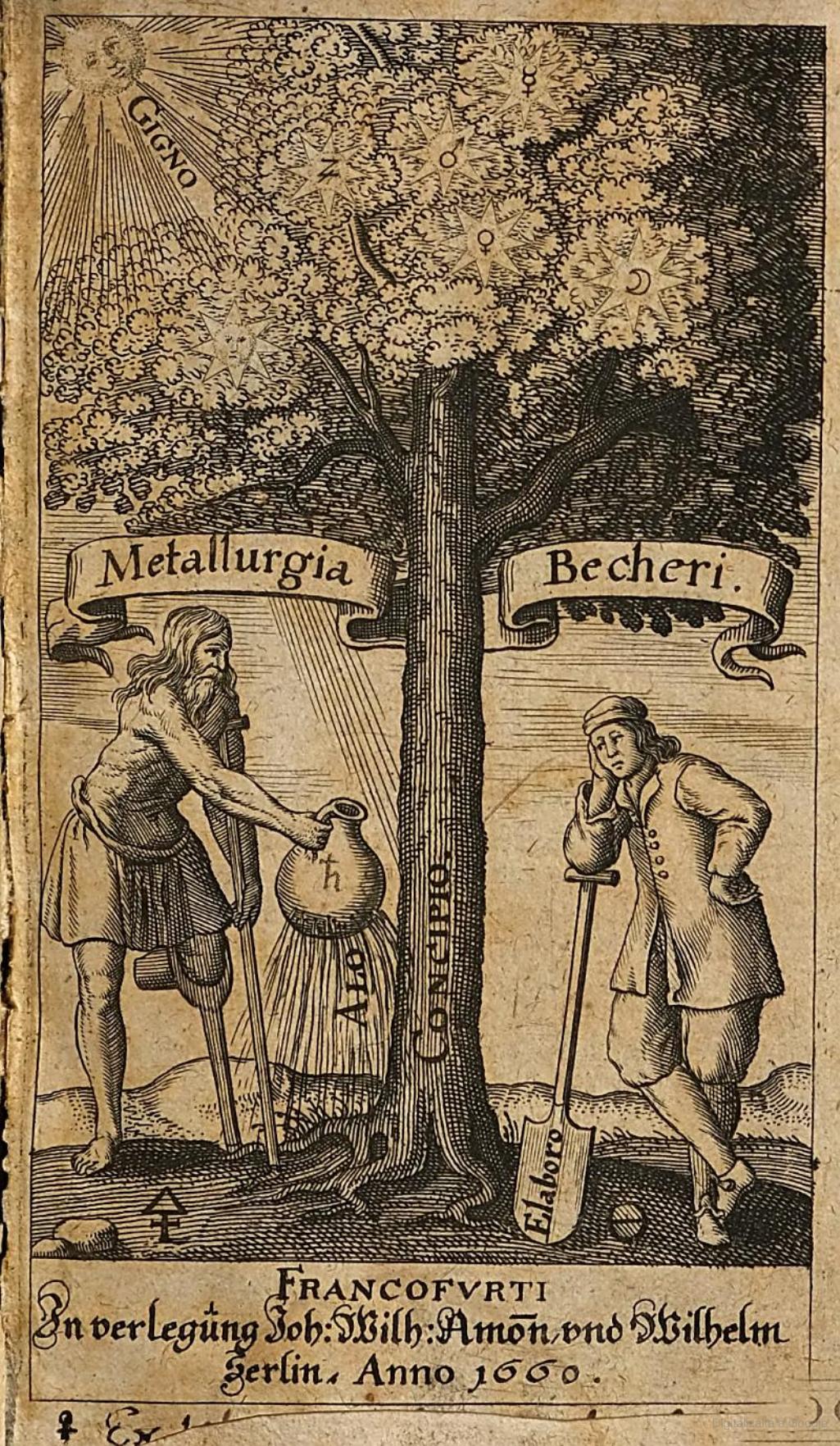
Endpaper to Becher J. J., 1661, Natur-Kündigung der Metallen, Frankfurt am Main, Ammon & Serlin.
Becher’s volume on metallurgy remained a reference, especially among scientists with an interest in alchemy, but the most cited author, whose Ampelographia, published in 1661, made the Tokaji gold grapes internationally famous, was the physician Philipp Jacob Sachs von Löwenheim (1627-1672) from Wrocław, Poland. In his Ampelographia, Sachs used Tokaji wines as an example when discussing sweet wines made from sweet grapes (vinum passum), and in chapter five, when examining the vineyards, he also discussed the phenomenon of the aurum vegetabile in detail, giving several examples of its occurrence in the Tokaj region and beyond (Sachs 1661, p. 40-44). According to Pierre Matthieu’s (1563-1621) story from 1602, in the village of Saint-Martin-la-Plaine near Lyon, Sachs reported that a farmer in a vineyard found stones glittering with gold, one of which resembled a plant leaf, which turned out to be pure gold. These were presented to King Henry IV of France. Finally, during subsequent exploration, an alleged rich gold mine was discovered in the same location5. Sachs also discussed a case near Dresden, where a winegrower found a gold cord on his property, which he pulled out of the ground and, after testing it with a so-called touchstone (lapis lydius), it was found to be gold of high purity (aurum obryzum). He continued the German examples by referring to the works of Alessandro Neapolitano, Antoine Mizauld, Gaudenzio Merula, and Giambattista della Porta (1535-1615): in the Neckar and Mainz regions, golden threads and leaves sprout from the ground. Alessandro Neapolitano linked this to the gold mines, where he said that the gold-bearing exudate hidden deep in the ground thickens, coalesces, solidifies, and is absorbed by the roots. Sachs had earlier expressed doubts about the veracity of this, but changed his position, firstly because of the aurum vegetabile mentioned by Becher, and secondly because his friends and correspondents, Martin Heinrich Franckenstein, physician from Eperjes (now Prešov, Slovakia), and Máté Held, court physician to Prince György Rákóczi II and later to Janusz Radziwiłł, a Lithuanian prince, had given several examples of the existence of this phenomenon.
Máté Held reported about an incident in 1651, according to which Prince György Rákóczi II, Prince of Transylvania in the company of his mother Zsuzsanna Lorántffy, his brother Zsigmond and his wife Henrietta Maria von der Pfalz-Simmern, saw grapes glistening with golden grains in the castle of Sárospatak near Tokaj. At the prince’s request, Held examined these grapes and described the shiny grains as real gold. According to Franckenstein, it is a regular occurrence in the Tokaj wine region for the plant gold to grow out of the ground with the grapes in the form of a spherical or angular rope-like formation (funiculus / dratt). This phenomenon was thought to be particularly common in places where the Terra Toccavienfis Alexipharmaca, the medicinal Tokaji bolus6, is found, which is rich in the essential auri sulphur; these are also the places where the best wines and the finest gold (aurum obryzum) are found7.
Fig. 2: Engraving showing the boluses in Christian Gottlieb Ludwig’s collection in his Terrae musei regii Dresdensis, Leipzig, Ex officina libraria Joann. Frider. Gleditschii, 1749.
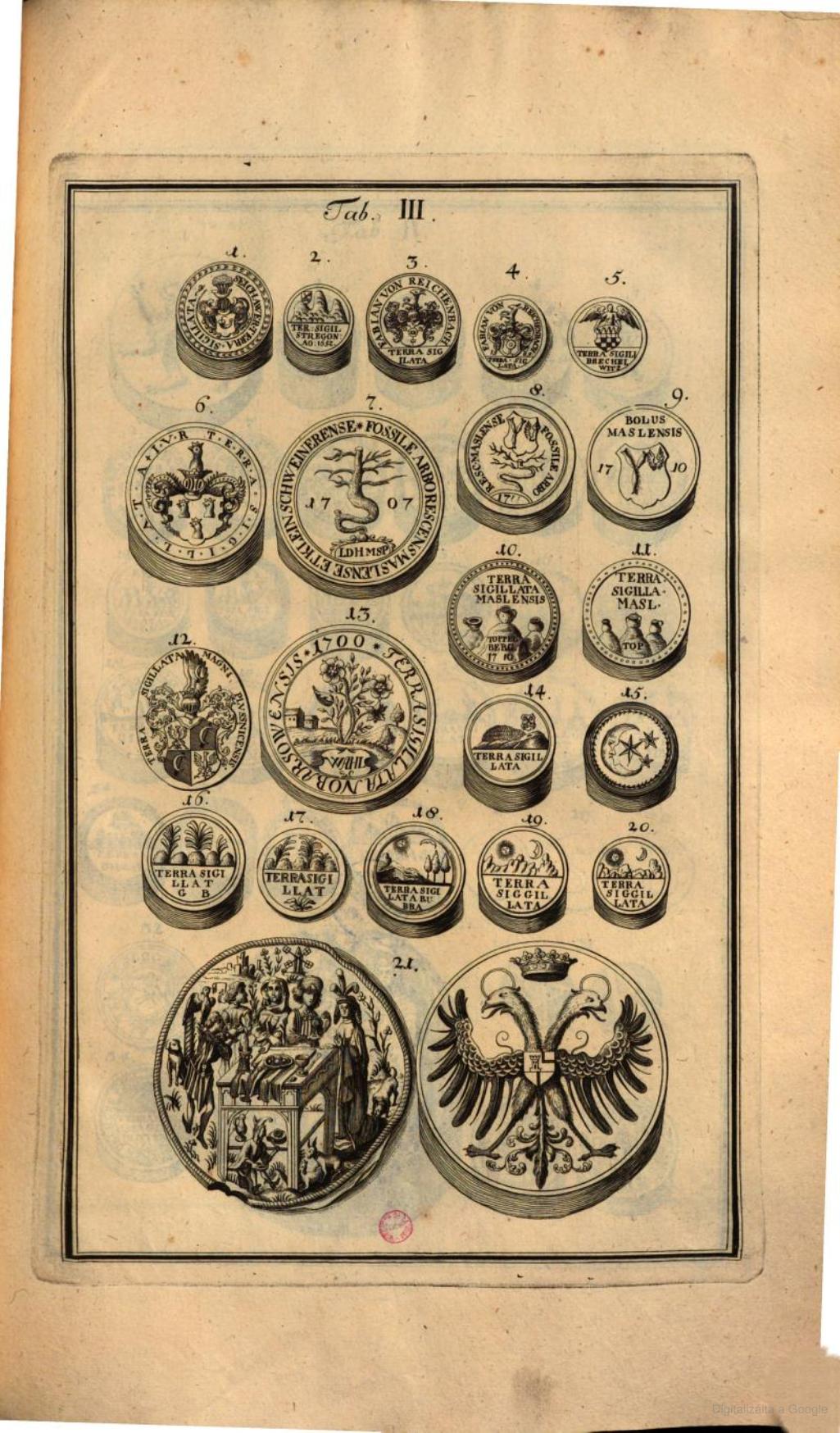
Ludwig C. C., 1749, Terrae musei regii Dresdensis, Leipzig, Ex officina libraria Joann. Frider. Gleditschii.
Sachs also noted that Procopius Polycarpus Bonanus (+ c. 1664), adviser to Archbishop György Lippay and from 1657 physician to the mining towns of Upper Hungary, collected many other examples in his forthcoming, but after his death lost, volume De Admirandis Hungariae.
Sachs was not only concerned with the unusual forms of gold in Ampelographia. As secretary of the Leopoldina, the German natural sciences society founded in 1652, he corresponded extensively with scientists of his time throughout Europe; he also regularly published his observations in the society’s journal Miscellanea curiosa, which appeared from 1670 onwards, and regularly published these letters alongside his own observations. Sachs was particularly interested in the different forms of gold: already in the first issue of 1670 he published a paper on the phenomenon of the transmutation of non-precious metals into gold (chrysopoeia), entitled Aurum Chymicum, in which, contrary to Athanasius Kircher’s (1602-1680) criticism, he presented the successfully performed transmutations, giving as examples several prominent royal and aristocratic participations (Sachs 1670, p. 65-75).
In the same issue he also published his knowledge of the aurum vegetabile (Sachs 1670, p. 290-293). In addition to the examples known in Ampelographia – Saint-Martin-la-Plaine, Dresden, Neckar and Mainz, and the Hungarian cases reported by Becher, Held, and Franckenstein –, he added several new cases to his list of examples. Near the village of Tarcza (now Torysa, Slovakia), about four miles from Eperjes, a peasant found a high-purity gold wire in the river of the same name, which was deposited in the Imperial Treasury. Georg Sebastian Jung (1642-1681), a court physician and member of the Leopoldina from 1670, reported on it when he described the treasury. He quoted Liceti on the occurrence of different metals in plants, highlighting the example of Szávaszentdemeter cited by Fregoso. His classification also showed that the phenomenon of the aurum vegetabile was not confined to Europe: he cited the American island of Hispaniola as an example referring to the book of the Italian historian, who served at the Spanish court, Pietro Martire d’Anghiera (1457-1526), called Legatio Babylonica8. This island was rich in gold and were trees, growing in the mountains, contained gold lines, gold also emerged from the roots, formed gold buds and grew continuously. Franckenstein’s new letter also gave other examples: in the vineyard of a Hungarian nobleman named Walpataky, his vine dresser found gold wire of excellent purity stuck deep into the ground, which he pulled out, but regularly regrew and stole from the “crop” until he had a dispute with Walpataky and even the duke over the ownership of the property. According to the doctor from Eperjes, this story became widely known in Tokaj-Hegyalja. Franckenstein also told Sachs that a few years ago, a farmer ploughing near Eperjes found a long gold wire, which he attached to the yoke of oxen when he transported wood to the town, and a local goldsmith identified the wire as being made of real gold. Sachs also emphasised that not only plant gold but also plant silver (argentum vegetabile) existed, evidence of which could also be found in various private collections – he listed several examples –, and he enumerated several contemporary explanations for the origin of this phenomenon. Plant metals allegedly can grow like a deer’s antlers and have no life in them. Trees, grapes, and other plants can absorb these metals with their roots. In support of this view, the author cited the theory of Athanasius Kircher, who also argued that plants absorb metal-saturated vapours from the lower layers of the earth and therefore take on their nature. Finally, Sachs quoted an observation by Johannes Faber (or Giovanni Faber, 1574-1629), a Bamberg-born physician, botanist, and secretary of the Accademia dei Lincei, who suggested that, by analogy with zoophyta, the intermediate species between animals and plants, there could also be intermediate (metallophyta) species between plants and metals, as first observed by Prince Bernard Caesius; this idea, which was edited in the Mineralogia, sive naturalis philosophiae thesauri in 1636, did not take root in the professional community.
A year later, Johann Paterson Hain (1615-1675), a Prussian-born doctor from Eperjes and a correspondent of Sachs, wrote a report to Sachs in Breslau, which was also published in the Miscellanea curiosa, adding fresh information to the legend (Hain 1671). His account is also significant because it is an excellent indication of the importance of the contemporary noble collections and the transnational correspondence between scientists in terms of scientific knowledge and, for our topic, the embedding of this legend. The author refers to a number of high-ranking individuals who were themselves a guarantee that the phenomenon of the aurum vegetabile was real and that its material remains were to be found in important treasure houses and curiosity collections. Johann Paterson Hain mentioned both the gold grains in the grapes and the gold particles and leaves growing from the grapes. According to his report, László Szemere, sub-prefect of Zemplén between 1667 and 1672, found a bunch of grapes in his own vineyard in 1670, the year before the publication, with every grain of gold and the skin of the grapes worn away by the metal. The sub-prefect thought that Hain might be interested in this bunch of grapes, but a soldier had ransacked his property and the grapes were lost. Szemere’s wife was wearing a gold thread wound into a ring on her finger, which she said had grown from a carrot, and she gave a piece of it to Hain, who sent it to an acquaintance of his, a scientist and inventor at the Polish royal court, Tito Livio Burattini (1617-1681) in Warsaw. According to Hain, the judge of Eperjes, Daniel Lengfelner (+1658), also had a similar bunch of grapes. Hain was shown a gold seed from gold grapes (aurum apyron), produced without fire, by “mother superior Rákóczi”, who was most probably Zsuzsanna Lorántffy (c. 1600-1660), wife of the Transylvanian Prince György Rákóczi I, who had established his court in the foothills of Sárospatak, and less probably Zsófia Báthory (1629-1680), wife of György Rákóczi II. Hain himself had a gold core taken from a bunch of grapes, which was presented to Aleksander Michał Lubomirski (+1675), Vaidowa of Kraków; it was tested by a goldsmith’s touchstone and proved to be 27 carats. He also presented him with a crystal two fingers long, clear on the upper part and with gold flecks on the lower part, which is described as still in his treasury. According to his letter, Hain also received such gold grains: the noble Péter Vay (1574-1656), sub-prefect of Szabolcs County, gave him one, which he picked with his own hands from a vine and pressed 40 semer – the weight of 40 grains of wheat – of the finest gold.
Hain has also reported extensively on the alleged gold particles and various plants gold. According to him, a peasant sold five small gold rings to a local goldsmith, who found them in the sandy bed of a stream near Bártfa (now Bardejov, Slovakia). This gold thread was quite thick, and he touched it himself in the presence of Countess Forgách. Perhaps the memory of this – or another lucky finding – is preserved in his sentence about sending Sachs, as a gift, a golden thread found by a peasant in the sand of a spring. Perhaps the most exciting account was about Ferenc Rhédey (c. 1610-1667), Prince of Transylvania, who presented him with a gold nugget weighing three drachmas, which, when it was still in the mine, appeared to be of a rather greasy consistency, similar to butter, but after it was mined it turned into solid gold.
Hain reported not only on existing memories, but also on a promise: Pál Gőczy (or Gönczy?) had promised him a small gold leaf, which had grown naturally on a gold particle, but after Gőczy died of the plague and his heirs lived in Kolozsvár (now Cluj-Napoca, Romania), Hain was unable to obtain it, although the deceased had promised him other special and exceptional things.
The above examples illustrate that the phenomenon of the aurum vegetabile – and of plant silver, Sachs also mentioned several examples of that – was not limited to Tokaj-Hegyalja and that the various royal treasuries noble and scholarly collections contained plenty of gold – or what were thought to be – objects that were considered to be examples of aurum vegetabile. These golden – or thought to be – objects were sent to each other as gifts, as was regularly done with occasional poems for example, and the large number of high-ranking recipients suggests that, here too, there was an alignment with the unwritten rules of the patron-client relationship9.
Sachs, as he has done several times in the history of the Miscellanea curiosa, added an educational supplement to this Observatio, called Scholion. In it, he presented Paracelsus’ view based on the 1636 volume Idearum operaticum idea by Jan Marek Marci (1595-1667), rector of the University of Prague. According to this, all metal and mineral things are different realisations of the same metallic nature. The manifestations of this are the metallic plants that spring from the nutritive power of the underground waters, some of which become like trunks, others like branches, roots, plants, flowers, fruits, or seeds. However, Marci expressed doubts, since not all the gold or silver plant parts or the various metals that form are found in some sites, explaining that the mineral waters dissolve and transport these parts away from the place of formation, where they are assembled into different forms. Sachs also suggested the possibility – another popular Paracelsian idea, shared by, for example, Kircher – that these gold particles rise from the vapours of evaporation in the ground and slowly accumulate in the subsoil where the vapour dissipates, the gold particles remaining there by their weight, coalesce and take the shape of the place. The same phenomenon could also cause the grape cuttings to turn golden, as Johann Daniel Major (1634-1693) suggested in his Dissertatio Medica De lacte Lunæ (1667).10 The fact that the solaris, or in this context “native” gold, is preferred by the grape to all other plants, Sachs believes requires further research, as Johann Tacke (1617-1676) indicates in his book called De consanguinitate auri, sacchari et spiritus vini, published in Gissi in 1659.
Sachs found an explanation for the buttery, soft, fatty gold found in the mine, mentioned by Johann Paterson Hain, by referring to Robert Boyle’s observations. Boyle (1627-1691), in his book Chymista scepticus vel Dubia et paradoxa chymico-physica,11 published in Genoa in 1677, reported hot vapours rising from the depths of the mines in Hungary, which were deposited in a greasy and shiny form on the walls in a few days. This, miners believed, would turn to gold or silver over time if they were left alone. Sachs did not mention it, but Boyle was actually referring to a commentary on Johann Popp (or Johannes Poppius, 1577–?) by a Leipzig-born physician Johann Agricola (1589-1643), published in 1638, under the name Commentaria notæ et observations in Johannis Poppii Chymische Medicin.
The greasy, soft, primitive form of the gold’s substance was not new: Johannes Montanus (1531-1604), based on the teachings of Paracelsus, explained the discovery of Silesian medicinal boluses in the local gold mines near Breslau (Montanus 1586). This theory has become quite well known in relation to the natural history of the aurum vegetabile of Tokaj and, in parallel and before that, the medicinal bolus of Tokaj. It is not possible to discuss this in detail within the scope of this study, but it is worth mentioning a few contemporary treatises that draw parallels with the appearance of plant gold.
Gold and Tokaj wines
Paul Keler, who was born in Bártfa (now Bardejov, Slovakia) and later became a wine merchant in Toruń in Poland, wrote a treatise on Tokaj wines at the Academic Gymnasium in the latter town, which was published in 1712 by Peter Jaenichen, rector of the school. Referring to the young Becher, Giambattista della Porta and Johann Tacke, Keler also mentioned the importance of the vapours coming from the soil, which he believed was the reason why the best grapes were grown at a certain point in a vineyard, and which was also the reason for the gold in the cuttings and bunches. But there is a legend in the legend itself, as he mentioned that, before the grape harvest, the winegrowers harvest the gold that has been produced in the meantime (Keler 1712, p. C2-C3).
Fig. 3: Evaporation and formation of metals underground in the second volume of Kircher A., 1665, Mundus subterraneus, Amsterdam, apub Joannem Janssonium & Elizeum Weyerstraten.
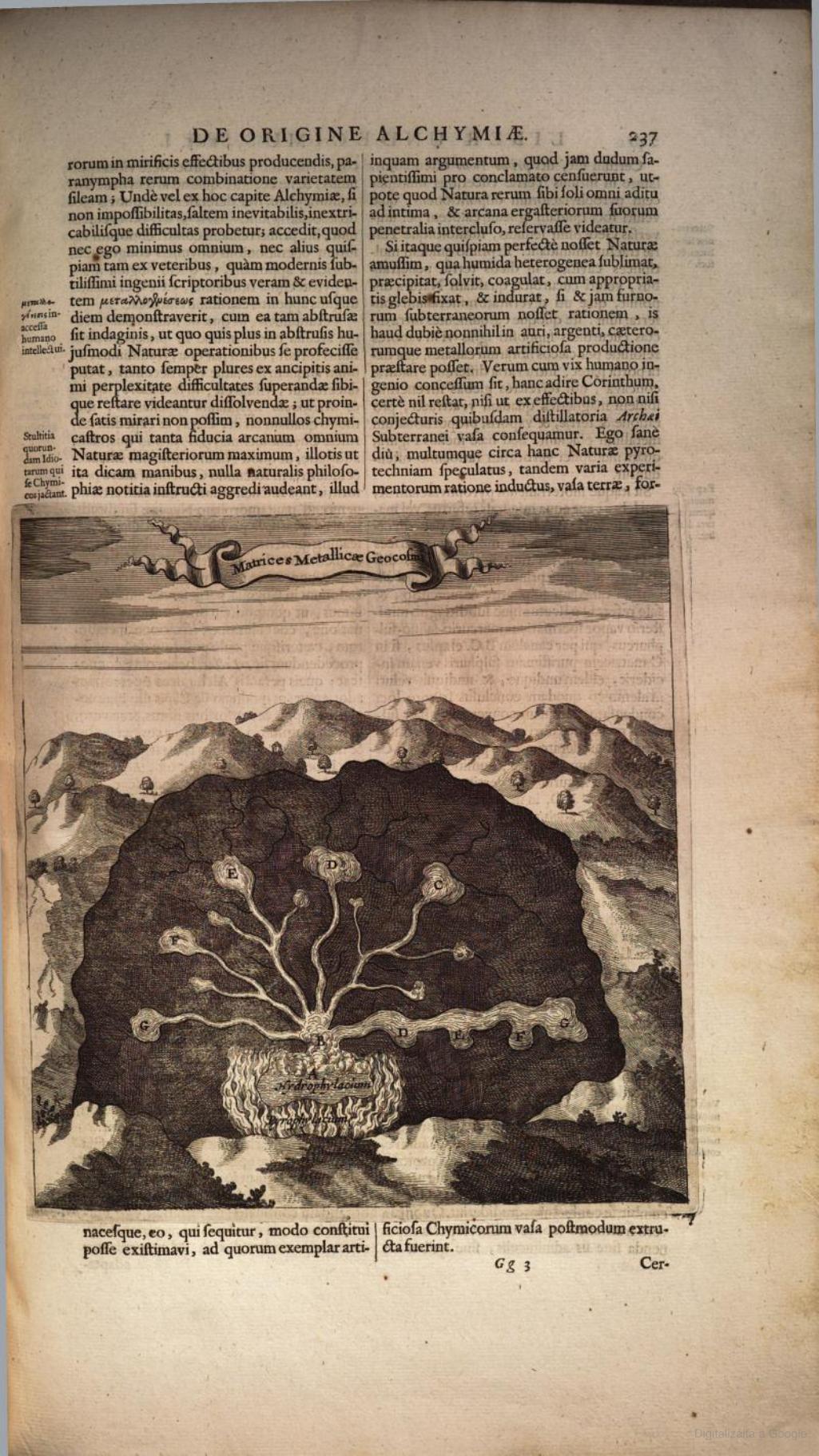
Credits: Kircher A., 1665, Mundus subterraneus, Amsterdam, apub Joannem Janssonium & Elizeum Weyerstraten.
The military geographer Luigi Ferdinando Marsili (or Marsigli, 1658-1730) also reported the existence of plant gold in his volume Danubius Pannonico-mysicus, which summarises his observations on the natural history of Hungary (Marsili 1726). Marsili was attracted not by the gold-containing grapes, but by a plant gold growing in spiral strands in the wheat fields near Zólyom (now Zvolen, Slovakia), and the locals were inspired to open gold mines – without much success. Marsili did not doubt the phenomenon of aurum vegetabile, but attributed the failure of it to the mountain’s internal structure, which he believed was strong enough to hold back the vapours coming from deep underground. His volume is also important because it contains several illustrations, such as Fig. 4 and Fig. 6, all of which are a real curiosity from the point of view of aurum vegetabile: he showed the gold threads extracted from the ground in the area of Zólyom, a site plan of the area with the position of the vineyards, mines and a thermal bath in relation to each other. The third illustration is the earliest known graphic representation of gold-bearing grapes: it includes two images of grapes with gold grains, with both the naked eye and under a microscope (Marsili 1726, p. 160).
Fig. 4: Grapes with gold grains.
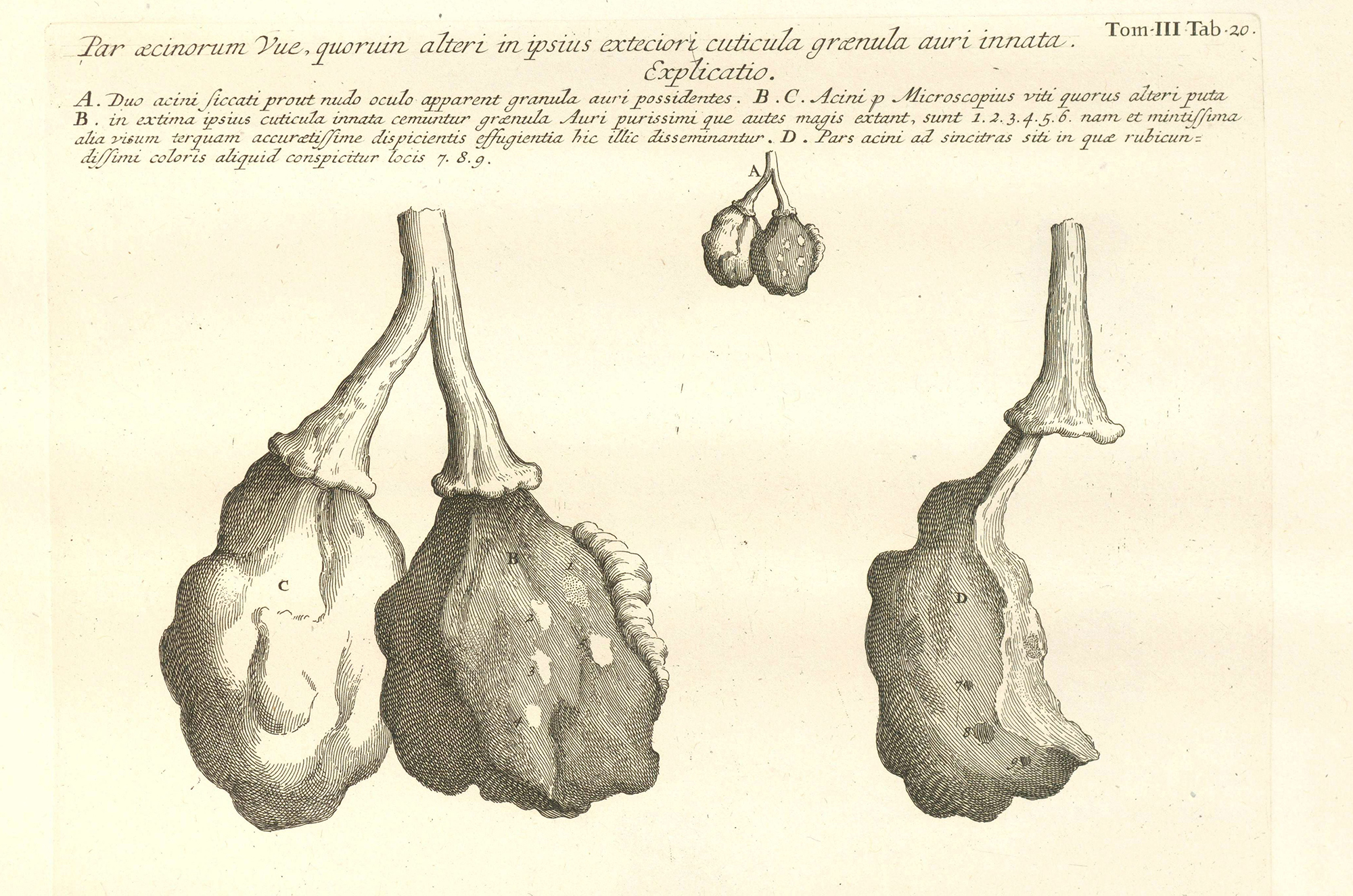
Marsili L. F., 1726, Danubius Pannonico-Mysicus, Den Haag and Amsterdam, P. Gosse, R. C. Alberts, P. De Hondt and Apub Herm. Uytwerf & Franç. Changuion.
The belief in the role of vapours from the depths of the earth persisted into the 18th century, as István Mihály Csiba (1673-1719) pointed out in his 1714 dissertation. The importance of this phenomenon was also emphasised by Dániel Perliczy in his 1773 dissertation in Vienna. In which, he actually shattered the belief in the aurum vegetabile, according to which the gold particles on grapes do not withstand fire tests and other experiments because they are deposited on the surface and inside the plants in a primitive, unhardened form.
Scientific criticism
It is interesting that the scientific critique of elementary gold grains arriving with vapours from the depths of the earth had already appeared in the early 18th century, although it had not yet become dominant. János Péter Komáromy (1692-1761), who later worked as the chief physician of Sopron and then Vas County, defended his doctoral thesis in Basel in 1715, in which he compared the medicinal properties of Sopron wines with those of Tokaj (Komáromy 1715, p. 13-25). In doing so, he did not take the easy way out, given the clear international reputation of the Tokaji wines: the comparison was based on the relationship between sulphur and gold, which was a major focus of Paracelsus’ medicine: according to the author, the reason why the vineyards in both places are so excellent and their medicinal properties so significant is that the soil of both areas is rich in sulphur and their inseparable gold. It was he who first refuted the influence of vapours from deep underground on the formation of aurum vegetabile in the Hungarian scientific discourse, since he described the appearance of plant gold not as being caused by these – which is just as much an imagination as the potable gold also used as medicine, id est aurum potabile –, but by the sulphur content of the soil and surrounding springs. Komáromy also admitted that he could not provide a rational explanation for the gold particles in plants, but he put forward three theories. The first explanation, which at first glance seems fabulous, is that when the flowers are in bloom, its leans more heavily on the soil, which is rich in overflowing particles, and the gold is attached to the flowers by some kind of elementary hooks, which are embedded in the small spaces between the flowers, and after blooming, they stick to the berries.
Komáromy’s second theory seems easier for the modern reader to accept – though it is also not true –, namely that these vineyards are rich in sulphur, which is also carried to the grapes by the exudate that carries the nutrients, and that the heat of the sun causes them to clump together into small particles that give the appearance of gold. A third idea is that a similar process takes place, but with elementary gold particles instead of sulphur.
Sachs’ Ampelographia and the reports in the Miscellanea curiosa proved to be extremely important in raising the international profile of the legend of aurum vegetabile: in addition to works of fiction, it was also cited in doctoral theses on the medicinal effects of Tokaji wines (Komáromy 1715; Welsch 1721; Domby 1758). In the first half of the 18th century, the legend was still considered to be true, such that the physician Samuel Köleséri (1663-1732), who, in his book on gold mining in Transylvania, listed several cases from Transylvania and the Hungarian town Bábolna (Köleséri 1717, p. 60), Johann Christoph Huber (+1770), who wrote his doctoral thesis on this phenomenon (Huber 1733), or the historian Mátyás Bél (1684-1749) who even published a copper engraving of the aurum vegetabile in Tokaj-Hegyalja (Bél 1723, p. 153).
The Jesuit monk and professor at the University of Nagyszombat (now Trnava, Slovakia), István Mihály Csiba, also described the legend as true in his Dissertatio historico-physica de montibus Hungariae, published in 1714 in the first chapter of De Montibus Auriferis, listing several examples that proved its alleged existence: Isidorus von Amelunxen’s report in 1073 that a certain Eckenricus had brought with him from Hungary grapes containing gold, which were seen and attested by respectable clergymen. He thought that this story was true and the earliest one about the Hungarian aurum vegetabile, but in 1905 it became clear that Amelunxen is just a fictional person found out by Christian Franz Paullini (1643-1712). Csiba also mentioned that, according to eyewitnesses, such bunches of grapes were kept in the treasury of Zsófia Báthory in Munkács (now Mukacsevo, Ukraine) (Csiba 1714, p. 20).
Mátyás Bél’s colleague, János Matolai (c. 1691/1692–?), who wrote a detailed description of the Tokaj wine region, also considered the legend to be true. According to his account, a local clergyman over 80 years old confirmed to him that in the vineyard called Aranyos in Tokaj-Hegyalja, a full golden grape was found during the Rákóczi War of Independence, which Ferenc Rákóczi ii sent as a gift to Tsar Peter the Great. This clergyman also claimed that a whole cluster of gold had been found there earlier (Matolai 1744, p. 15-16).
Fig. 5: Engraving of gold tendrils wrapped around vines in Tokaj, presumably Late Bronze Age bangles.
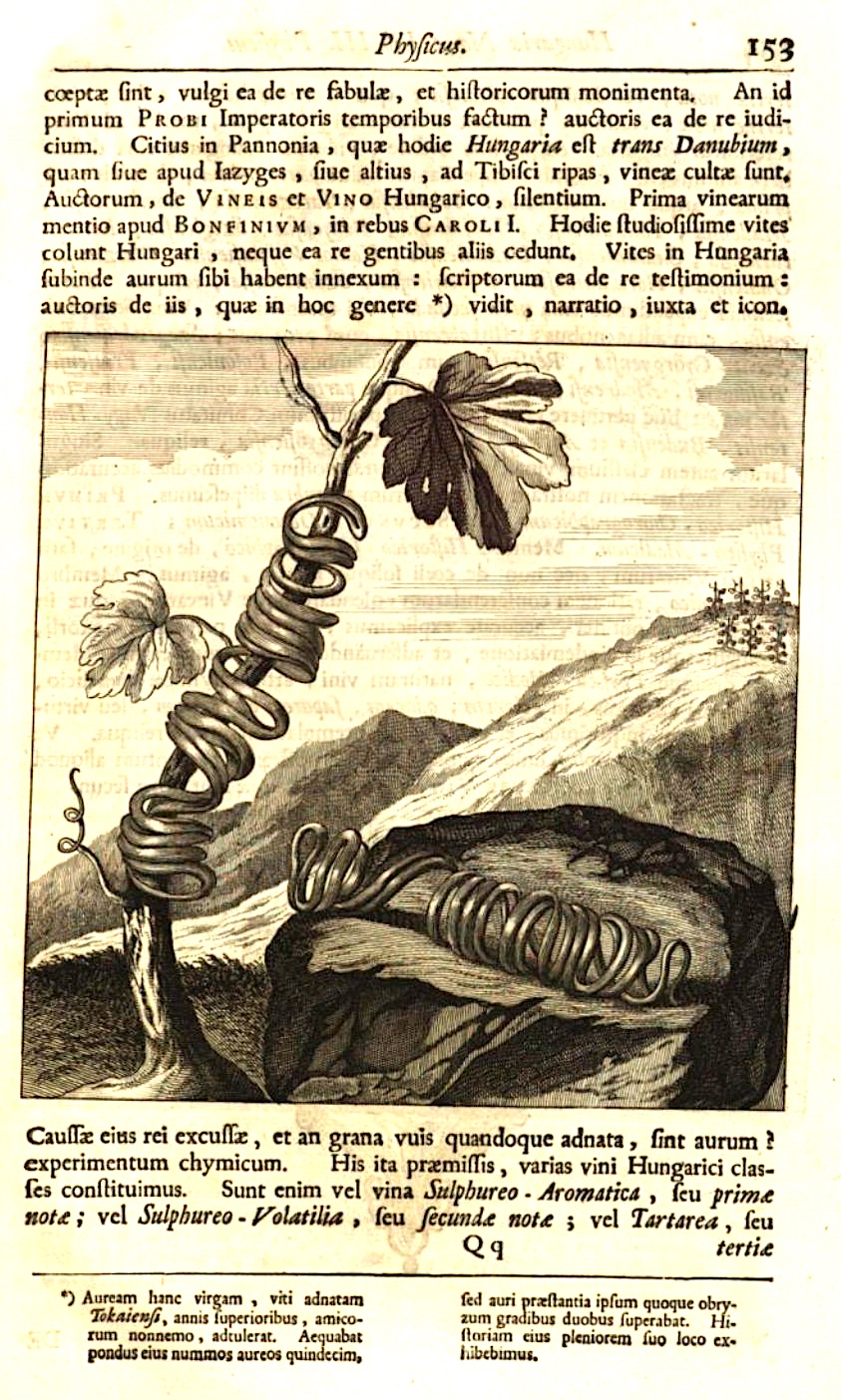
Bél M., 1723, Hungariae antiquae et novae Prodromus, Nuremberg, Sumtu Petri Conradi Monath.
Despite all attempts to justify it, belief in the reality of plant gold declined by the early 18th century. Johann Adam Raymann (1690-1770), a doctor from Eperjes, was the first to subject these alleged gold particles to scientific tests (Raymann 1720; Raymann 1722; Raymann 1742). He showed that this material could not be a true precious metal, because it was much lighter than real gold, was not refractory and, when mixed with mercury, did not form amalgams. He also pointed out that the alleged golden grains dissolve in the must, and their formation is thought to be caused by the sun and because the juices in the ripe berries become sticky. Referring to Raymann, the physician Daniel Fischer of Breslau (1695-1746) refuted the legend of the aurum vegetabile in 1732, in addition to the medicinal properties of Tokaji bolus (Fischer 1732, p. 60–69). In his medical dissertation on the medicinal properties of Tokaj wines, published in Utrecht in 1758, Sámuel Domby (1729-1807) also took a cautious position (Domby 1758, p. 23-24; reprinted version: Domby 2022, p. 127-129). With reference to Raymann, he partially refuted the legend of the aurum vegetabile, more precisely the existence of tiny gold particles in the grapes, but left it to further investigation to determine why the natural gold in the soil and the medicinal effects of Tokaji bolus were beneficial to the growth of the grapes and the medicinal effects of the wines made from them.
The existence of plant gold was only commonly rejected after István Weszprémi (1723-1799) refuted its existence in German in 1773 and in Hungarian in 1795 (Weszprémi 1773; Weszprémi 1795). He proved that the aurum vegetabile was a misunderstanding based upon false scientific assumptions.
Fig. 6: Gold tendrils, probably Late Bronze Age gold-wire fragments, found near Zólyom / Zvolen.
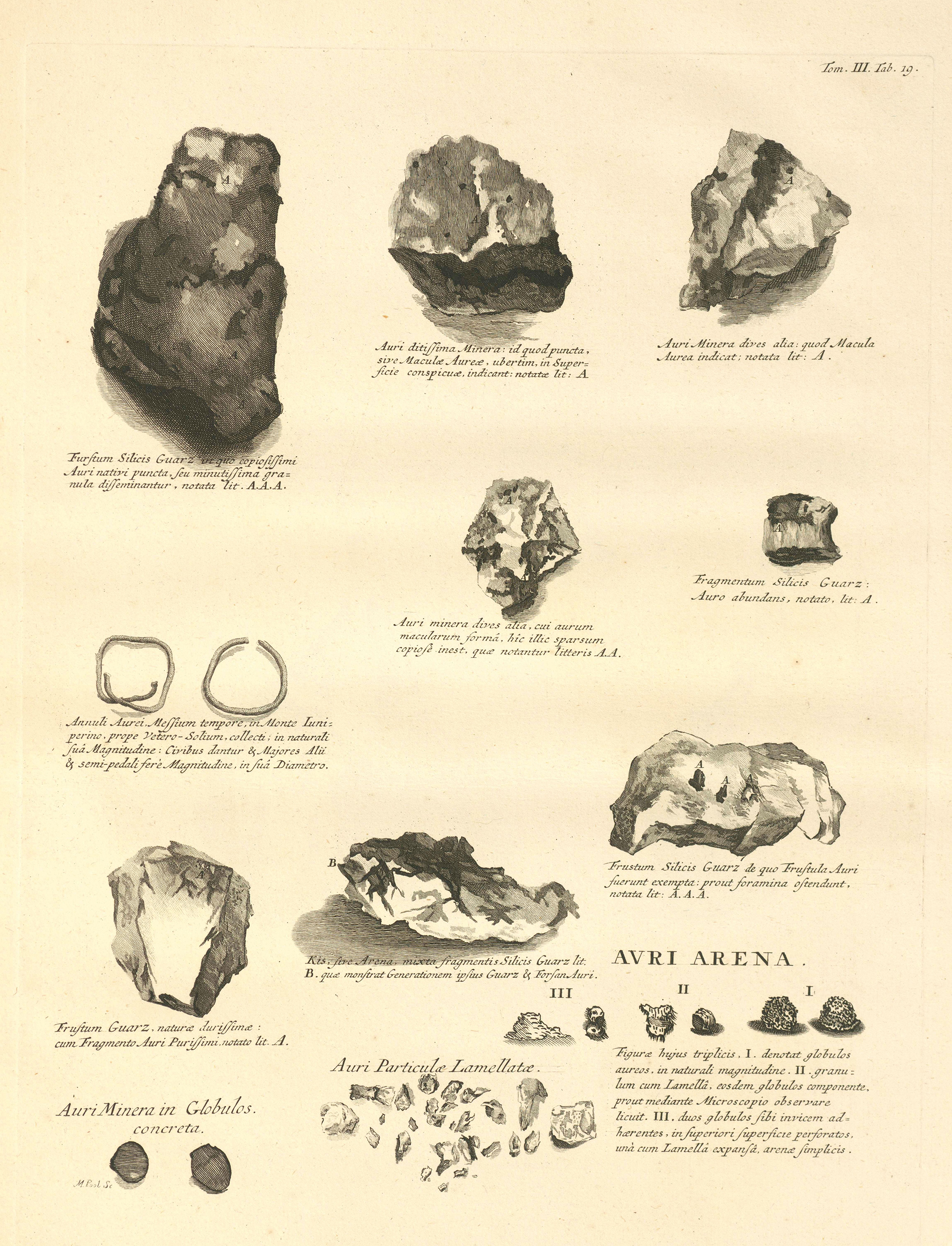
Marsili L. F., 1726, Danubius Pannonico-Mysicus, Den Haag and Amsterdam, P. Gosse, R. C. Alberts, P. De Hondt and Apub Herm. Uytwerf & Franç. Changuion.
Epilogue
By the end of the 18th century, not only the theory of aurum vegetabile, but also the theory of other metals that were allegedly formed from vapours seeping upwards from the depths of the earth, had become obsolete. For example, Antal Szirmay (1747-1812), a nobleman from Tokaj-Hegyalja who wrote the history of Zemplén County, not only doubted the phenomenon of aurum vegetabile, but also recorded that it had been previously believed to be as follows: the excellent properties of Tokaj’s soil were due to the metals it contained, especially its high gold content, but this has been repeatedly refuted: Daniel Fischer for bolus and Adam Raymann for plant gold. The author admits that even he himself was deceived by his ancestors’ beliefs, since in 1779 he himself published in Ephemerides Vindobonenses that he had found a cluster of grapes in his vineyard in Mád, shining with golden grains. These were examined by the University of Vienna in 1780, at the request of the emperor, and found to be nothing more than insect eggs. The aforementioned 1773 rebuttal was published in the journal Kaiserlich Königlich allergnädigst privilegietre Anzeigen aus sämtlichen kaiserlichen königlichen Erbländern, which contains several articles of discussion on the aurum vegetabile. In these, scientists, indicated only by initials, stated that metals could never combine with plants (Balassa 1991, p. 430–431; Szirmay 2022, p. 410-411).
Fig. 7: Drawing of the Gonocerus acutangulatus and its eggs in Horváth G., 1895, Az aranytermo szőlők meséje, Természettudományi közlöny, október, no 314, p. 505-514.
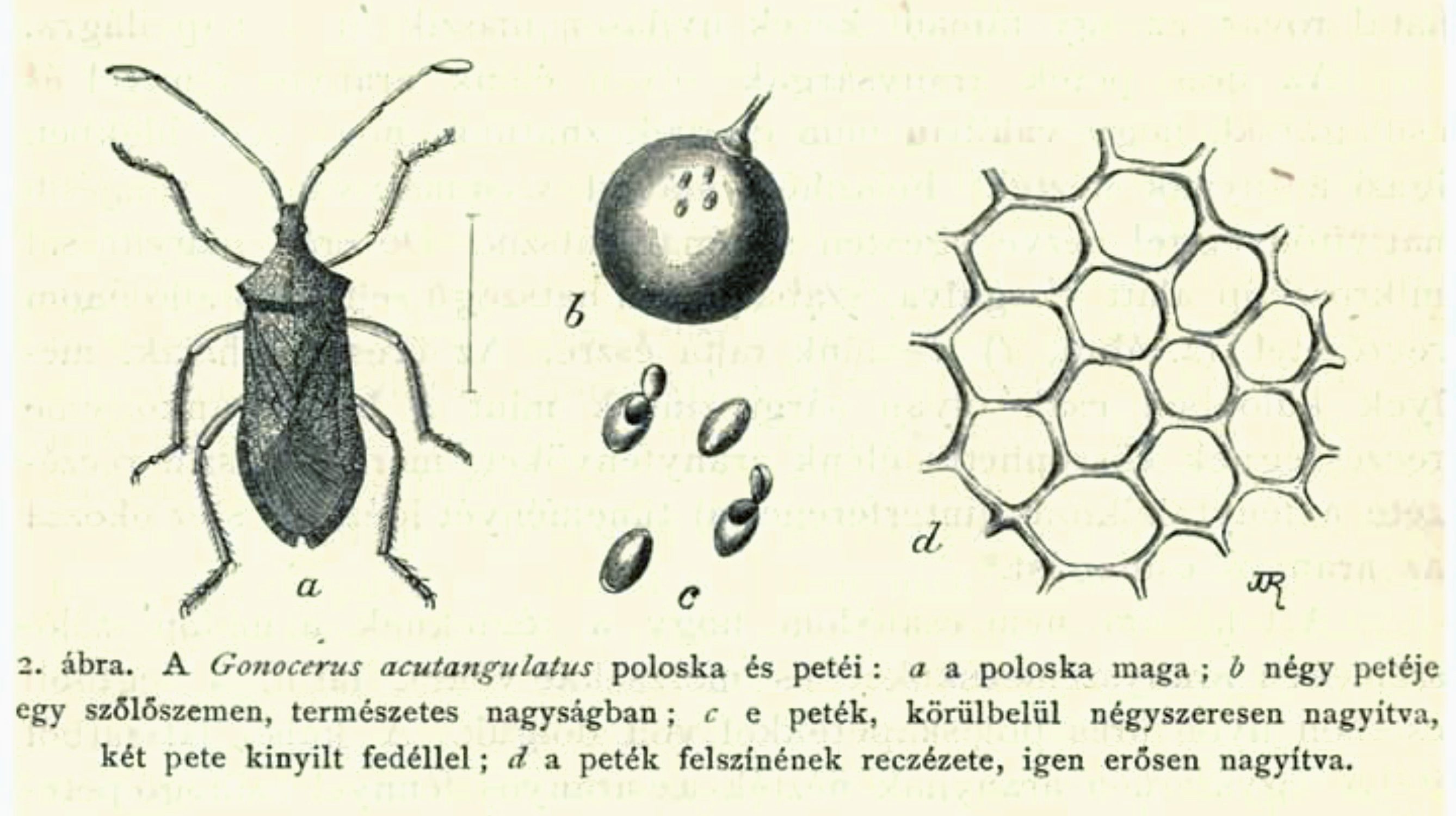
Géza Horváth, 1895.
In 1895, Géza Horváth once again refuted the legend of the aurum vegetabile in the pages of the Természettudományi Közlöny (Horváth 1895). The author emphasised that these gold particles and tendrils existed in reality, since they were also used to make jewellery, but they were probably prehistoric archaeological finds. However, the gold glittering inside the grape berries must have been an optical illusion, just as the golden grains on the surface of the grape seeds must have another explanation. According to Raymann and Weszprémi, they were a gluey substance that leached out of the grape seeds and solidified on the skin of the grapes. Not dismissing this possibility, Géza Horváth proved that they were largely the eggs of a species of Hemiptera or commonly called box bug, alias Gonocerus acuteangulatus. The author examined a grape seed sent to the Natural History Society for examination by the Arad pharmacist Mátyás Rozsnyay (1833-1895), on which four golden-coloured and shiny grains were visible. The aurum vegetabile thus became truly obsolete, or rather a true legend.
Fig. 8: Late Bronze Age gold treasure from Bodrogkeresztúr, found in 1918.
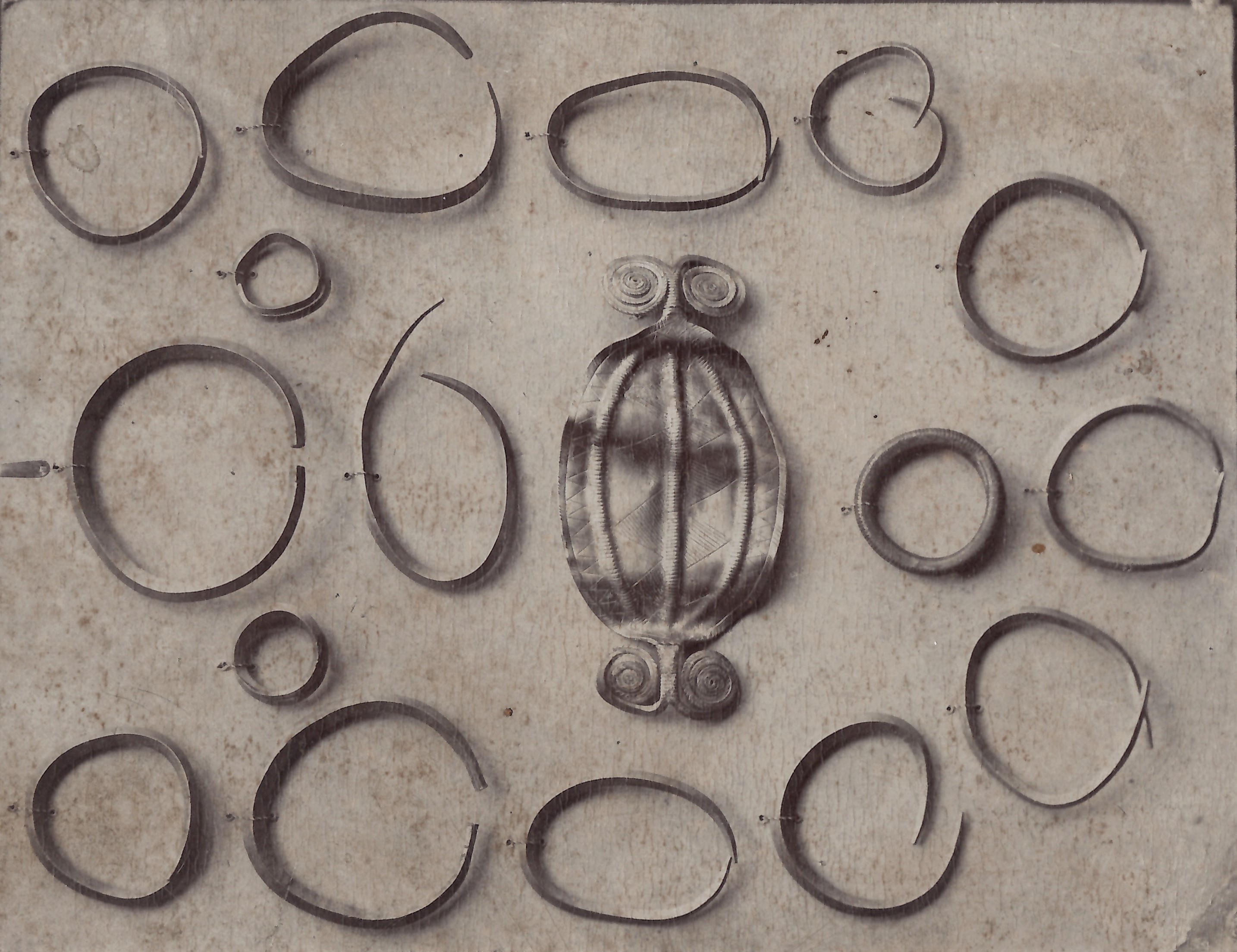
Archival photograph from the archaeological collection of the Kazinczy Ferenc Múzeum, Sátoraljaújhely.
In the case of the aurum vegetabile, we cannot only talk about a myth but also its unconscious appropriation. As can be seen, the plant gold, of which there were many occurrences throughout Europe in the Middle Ages and the early modern period, and whose realizations were increasingly associated with the vineyards, caused a significant headache for the scholars of the time. We already know that Géza Horváth was indeed right: these gold threads came mainly from the various underground depots of the Late Bronze Age archaeological sites, for example the gold treasures in Bodrogkeresztúr or Sárazsadány – both can be localized near to Tokaj – (Kovács-Raczky 2000, p. 71; Tarbay 2025, p. 26-27) and the “gold grains” found in grapes were actually insect eggs, but scientists of the time were investigating the causes and coming up with answers that were credible to their level of knowledge. This knowledge has been almost completely lost over the centuries, making it difficult to examine the Tokaj wines, bolus and aurum vegetabile together, as it was unambiguously done in the 17th and 18th centuries. Another problem was that until recently, it could be read in the Hungarian literature that this phenomenon was specific to the Tokaj wine region, which was clearly not true. In conclusion, the present study has attempted to refute not one, but two myths.
Fig. 9: Map of early modern aurum vegetabile archaeological sites in Europe.
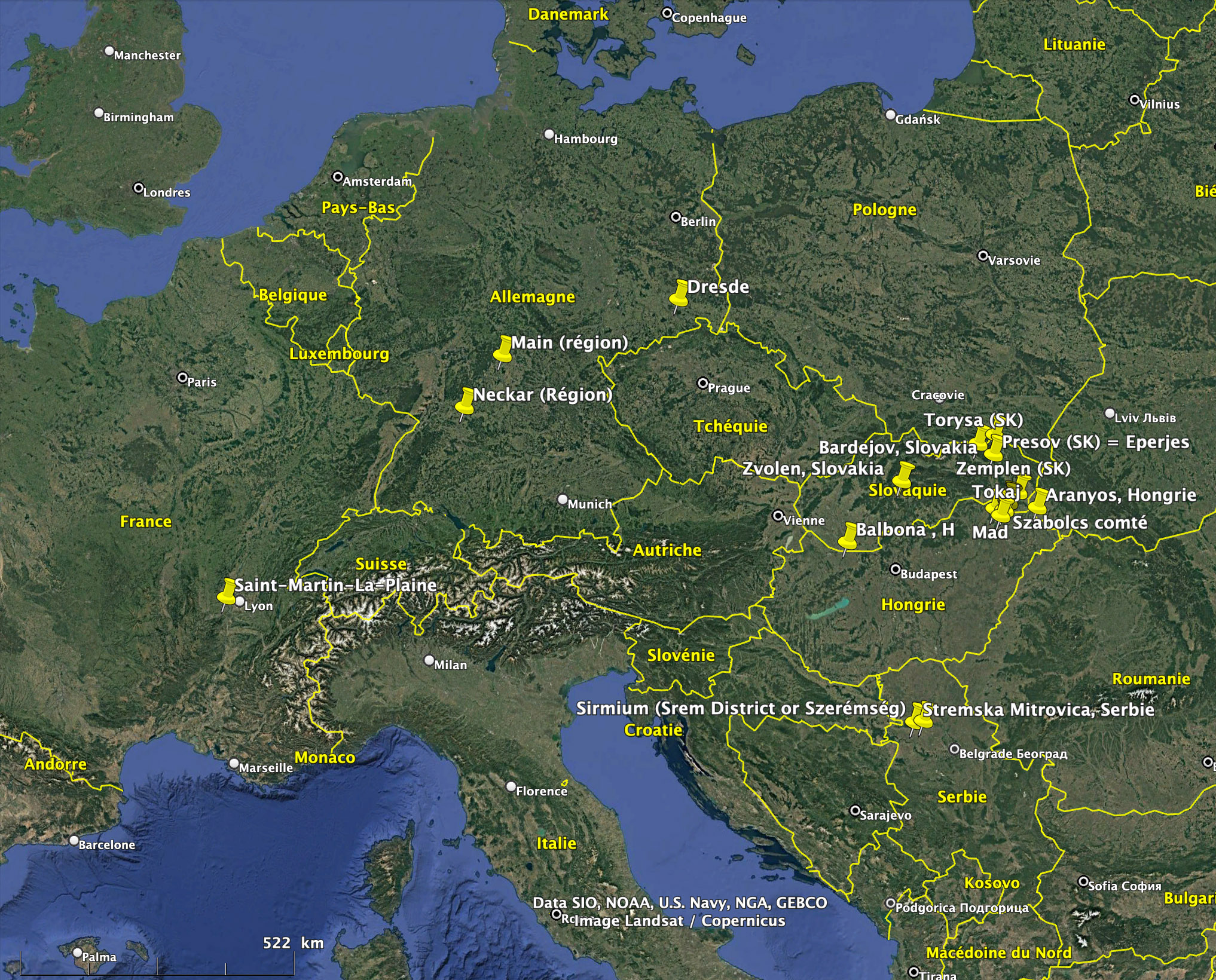
Jean-Pierre Garcia, base map : Google Earth.